How do you turn raw geospatial data into sharp insights that really make a difference? In this one-on-one course, you’ll learn how to use geospatial information to make area-specific plans visually and substantively compelling. With personalized guidance, interactive online modules, and hands-on assignments, you’ll discover techniques that often go unnoticed. Ready to see what’s truly possible with geospatial data?
Area-Based Approach
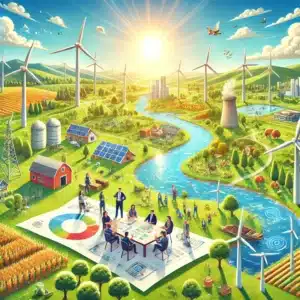
Area-based working is an approach that focuses on what makes an area unique: its characteristics, challenges, and the people who live or work there. You seek smart solutions to societal issues such as climate adaptation, housing development, or nature conservation. You don’t do this alone, but in collaboration with stakeholders such as governments, businesses, residents, and environmental organizations. This allows you to use the available space and resources in a way that suits the area.
The approach begins with an analysis of the area: what does it look like, what issues are at play, and who is involved? Geospatial data helps gain insight into spatial challenges. Based on this, you jointly develop a clear vision: what do we want to achieve, and how will we go about it? This collaboration forms the basis for planning, decision-making, and implementation.
Of course, there are also challenges. Interests can clash, for example when economic growth conflicts with nature conservation. The challenges are often complex and touch on multiple themes simultaneously, such as water management, agriculture, and biodiversity. Moreover, space is often limited, and clear agreements are essential. Collaboration requires trust and clear communication, and changes in legislation or circumstances demand flexibility.
Yet it is precisely this complexity that makes area-based working so interesting. Especially for those who work with geodata and spatial issues, this approach offers the opportunity to make a real difference.
What will you learn in this Blended Learning course?
In this course, you will learn how to effectively apply area-based working in practice. You will discover how to integrate spatial information, the interests of various stakeholders, and policy objectives into a single, clear plan. In doing so, you will develop skills to work in a dynamic environment where governments, residents, businesses, and environmental organizations collaborate to find solutions. For example, you’ll learn how to use geodata to gain insight into spatial challenges and how to translate those insights into feasible choices.
The course content aligns with current themes such as sustainable area development, participatory decision-making, and spatial planning. You’ll work on concrete issues and learn how to use geoinformation effectively in communication and decision-making. Do you work for a government agency, consulting firm, or organization involved in spatial planning? Then this course offers you exactly the knowledge and skills you need to get started with area-based work with confidence and impact.
Why choose this Area-Based Planning course?
Blended learning combines independent online learning with practical, interactive sessions, allowing you to gain both theoretical knowledge and practical experience in area-based planning and stakeholder analysis. The online modules give you the freedom to learn wherever and whenever it suits you. They include interactive lessons on spatial planning, sustainable area development, and the use of geoinformation in policymaking. You’ll discover how to effectively analyze geodata, how to identify the interests of various stakeholders, and how to work toward a shared vision for the area.
During the practice-oriented online sessions, you’ll immediately apply the knowledge you’ve gained. You’ll work on realistic area-specific cases and receive guidance from experienced professionals in area-oriented work. In doing so, you’ll learn how to organize participation, weigh interests, and support decision-making using geoinformation. You will also practice drafting integrated plans that balance spatial, ecological, and social interests. In this way, you bring theory and practice together in a manner that is directly applicable to your professional field.
The combination of flexible online learning and practical training ensures that you not only learn to work with the theory behind area-based planning but also how to apply it effectively within spatial projects. After completing this course, you will be able to independently conduct an area analysis, structure complex interests, and contribute to sustainable and widely supported solutions. In this way, you will grow into a professional who can contribute with insight and confidence to the spatial challenges of today and tomorrow.
You'll receive personalized guidance. After you register, our course coordinator will contact you to schedule your first session.
Learning objectives
After completing this course, you will be able to:
Use geographic information to analyze an area quickly and effectively.
Identify the interests of stakeholders and incorporate them into a land-use plan.
Combine online learning modules with practical assignments for effective knowledge building.
Use geodata to make informed decisions in spatial projects.
Clearly present spatial information for consultation and decision-making.
Want to know more?
Do you have questions about the course content? Or are you unsure whether the course aligns with your learning goals or preferences? Would you prefer an in-company or private course? We’d be happy to help.