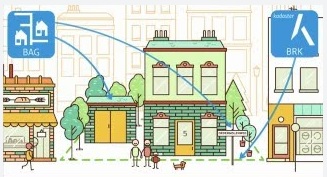
How can you make the most of the Basic Register of Addresses and Buildings (BAG) in your work? In this one-on-one course, you’ll learn how to effectively manage, analyze, and apply BAG data in QGIS to gain valuable geospatial insights. You’ll receive personalized guidance and work on practical assignments and online modules. This will help you develop immediately applicable skills that allow you to solve complex problems quickly and efficiently.
BAG: Basic Register of Addresses and Buildings
The Basic Register of Addresses and Buildings (BAG) is one of the most important data sources for geographic information in the Netherlands. It contains detailed and up-to-date data on addresses, buildings, and associated geometries throughout the country. Whether you work in property management, urban planning, or at a government agency that relies on reliable location information, the BAG is of crucial importance.
With the BAG, you can manage accurate information about every registered address and building. This is essential for property management and urban development. The BAG also contains geographic coordinates for buildings and addresses, allowing you to perform analyses. You can create visual representations in GIS software such as QGIS. Furthermore, you can combine the BAG with other data sources to gain valuable insights. These include information on population density, property values, or the accessibility of public amenities.
This course provides the basic knowledge you need to work effectively with the BAG. Whether you work with geodata, use a GIS system, or want to apply BAG data in your work, this course covers the fundamental knowledge and skills.
What will you learn in this Blended Learning course?
In the Blended Learning BAG Basics course, you’ll gain comprehensive knowledge of the Basic Register of Addresses and Buildings (BAG). You’ll learn not only how this data is structured but also how to use it effectively in your daily work. The course provides you with the tools to manage, analyze, and apply BAG data in GIS software such as QGIS.
You will learn to understand the structure of the BAG. Additionally, you will discover how to apply the data in various situations, such as managing addresses and buildings or performing spatial analyses. The course focuses on using BAG data to gain valuable insights. You can then use these insights for decision-making and policy. This enables you to effectively integrate the BAG into your work processes and make optimal use of the available geoinformation.
Why choose this BAG Basic course?
Blended learning combines flexible online learning with interactive, practical sessions. This approach ensures that you not only gain theoretical knowledge about the Basic Register of Addresses and Buildings (BAG), but also learn how to apply this knowledge in practice. The online modules give you the freedom to study at your own pace, with interactive lessons that focus on the structure of the BAG, the management of BAG data, and how to process it in QGIS for geospatial analyses.
During the hands-on online sessions, you can immediately apply the knowledge you’ve gained. You’ll work with real BAG data and receive guidance from experts. You’ll learn how to effectively manage BAG data, perform spatial analyses with QGIS, and efficiently share and integrate this data into your work processes. By working hands-on with realistic geodata scenarios, you’ll develop practical skills that enable you to ensure accurate and up-to-date BAG data—which is crucial for applying geodata in various applications.
The combination of flexible online learning and hands-on training ensures that you not only learn how to work with the BAG, but also how to effectively use it for geospatial analysis and project management. After this course, you will be able to work independently with the BAG, analyze and apply data, so that you can make well-informed decisions in your work.
You'll receive personalized guidance. After you register, our course coordinator will contact you to schedule your first session.
Learning objectives
After completing this course, you will be able to:
Manage and analyze BAG data using QGIS to ensure accurate geodata.
Process building and address geometries from the BAG for analysis.
Use BAG data in your work processes for better decision-making.
Perform spatial analyses using the BAG and QGIS.
Share and synchronize BAG data for efficient collaboration.
Want to know more?
Do you have questions about the course content? Or are you unsure whether the course aligns with your learning goals or preferences? Would you prefer an in-company or private course? We’d be happy to help.