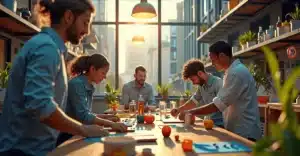
How can you transform a city simply by learning about it? In this one-on-one course, you’ll discover how to turn an ordinary neighborhood into an urban lab—a place where data, people, and ideas come together to tackle real-world urban challenges. You’ll receive personalized guidance as you learn how to use geodata and geospatial tools to devise smart solutions that can be immediately applied in practice.
A City Lab
The city is more than just the backdrop for your learning process—it is your learning environment. In City as Lab, you use urban space as a dynamic field for research, analysis, and innovation.
The starting point for this approach is the city lab: an innovative working method in which residents, researchers, and entrepreneurs collaborate on current urban issues. Think of themes such as sustainability, livability, or social inclusion. In a city lab, the city itself becomes the laboratory—a place where ideas are generated and immediately tested in practice, often right in the heart of a neighborhood or district.
This way of learning connects theory with reality. You’ll learn to approach urban problems from different perspectives and using geodata and geospatial insights. This allows you to develop concrete solutions that address what’s really happening in the city.
By collaborating in an environment where disciplines intersect, you experience what it means to learn with and from the city. The result is a learning process that is just as dynamic as the urban context itself.
What will you learn in this Blended Learning course?
In Blended Learning: City as Lab, you’ll delve into urban issues and learn to analyze and tackle them using geoinformation, geodata, and insights from various disciplines. You’ll receive a clear introduction to the concept of the city lab: what it entails, how to set one up yourself, and which stakeholders and resources are essential for success.
You’ll discover how collaboration between residents, policymakers, and researchers takes shape in practice. You’ll also learn what challenges you might encounter and how to demonstrate the impact of a city lab. Through three clear perspectives, you’ll gain insight into what makes a city lab effective, how to collaborate in a complex urban environment, and how to measure what works—and what doesn’t.
During the course, you’ll develop skills to approach urban issues from different angles. You’ll learn to read and interpret data, make connections, and translate ideas into tangible solutions. Using realistic case studies, you’ll work on real urban problems, learning how the city itself becomes a laboratory where you research, test, and improve.
So you’ll learn not only about the city, but also with the city—and that makes your learning experience powerful, relevant, and immediately applicable.
Why choose this City as Lab course?
Blended learning in City as Lab combines in-depth content with practical application, so you gain both theoretical insights and practical skills in working with urban issues and geodata. Through the online learning environment, you study at your own pace, with interactive modules focused on urban dynamics, participatory methods, and the use of geospatial tools within an urban context. You’ll learn how to collect and analyze relevant data and translate it into clear spatial insights that you can apply immediately.
During the practice-oriented online assignments, you’ll immediately apply your knowledge to realistic urban situations. You’ll work with real data from neighborhoods and districts, analyze patterns, and identify problems. You’ll then explore which solutions are feasible, who to involve, and how to measure the impact. By working on concrete cases, you’ll strengthen your ability to think from multiple perspectives and make well-founded decisions.
This combination of independent learning and practical thinking ensures that you not only understand what an urban lab is, but also how to set one up and manage it yourself. You’ll develop a keen insight into urban systems, learn to collaborate effectively with various stakeholders, and use data to design sustainable and widely supported solutions. This will prepare you to make a difference in the real world—where it matters most: in the city.
You'll receive personalized guidance. After you register, our course coordinator will contact you to schedule your first session.
Learning objectives
After completing this course, you will be able to:
Explain what urban labs are and how they help solve urban challenges.
Set up and organize an effective urban lab yourself.
Identify the challenges you’ll face when working with urban labs and how to address them.
Measure and improve the impact of an urban lab using geodata and geospatial insights.
Analyze data to find solutions to real-world problems in the city.
Want to know more?
Do you have questions about the course content? Or are you unsure whether the course aligns with your learning goals or preferences? Would you prefer an in-company or private course? We’d be happy to help.