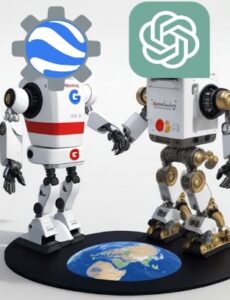
By offering the Google Earth Engine ChatGPT Course, Geo-ICT brings the possibilities of advanced geospatial analysis within reach for anyone interested in the future of geoinformation. This course is not only an introduction to the basics of geospatial data and satellite image analysis; it is also a deep dive into how these technologies can be applied to real-world problems. Discover how combining advanced geospatial analysis with the power of AI can provide insights that make a world of difference.
This course requires some prior knowledge of Google Earth Engine; if you do not have this, please check out our Google Earth Engine Basics course.
The Basics of Geospatial Data
When diving into the world of geospatial technologies, it’s crucial to start with the basics: geospatial data. But what exactly does this mean? Geospatial data, or geodata, encompasses all information associated with a geographic location on Earth. This data enables us not only to see the world around us but also to understand and analyze it through the lens of location.
There are two primary forms of geospatial data: vector and raster data. Vector data consists of points, lines, and polygons that represent physical locations on Earth—such as properties, cities, roads, mountains, and bodies of water. On the other hand, raster data represents the Earth through pixels. Each pixel in a raster file has a specific location and often a value that indicates, for example, color or temperature.
The power of geospatial data lies in its ability to understand and solve complex spatial problems. Whether it involves tracking vegetation changes over time, analyzing urban expansion, or optimizing transportation routes, geospatial data provides the insights necessary for effective decision-making.
Geo-ICT recognizes the importance of this foundation and integrates it into the Google Earth Engine ChatGPT Course. By introducing students to both the theoretical and practical aspects of geospatial data, they are equipped with the necessary skills to perform advanced analyses. From image classification to the integration of natural language processing with ChatGPT, the course offers a solid foundation in the world of geospatial technology. Dive deeper into the subject with Geo-ICT and discover how you can make a difference in the world with the power of geodata.
The Role of Satellite Imagery in Environmental Monitoring
Satellite imagery plays an indispensable role in modern environmental monitoring. By observing the Earth from space, it offers a unique perspective on the changes our planet is undergoing. These images are not only essential for mapping physical changes, such as deforestation, urbanization, and the effects of climate change. They are also vital for tracking the health of our natural environment in ways that were previously impossible.
One of the most powerful tools in this field is Google Earth Engine. This tool combines a vast amount of satellite imagery data with cloud-based processing. This enables scientists, policymakers, and environmental activists to perform rapid analyses across large time periods and geographic areas. Whether it’s tracking vegetation changes to optimize land use or identifying vulnerable ecosystems that need protection. Satellite imagery enables us to take action based on concrete data.
Geo-ICT fully leverages these capabilities by offering the Google Earth Engine ChatGPT Course. Here, students learn how to use this powerful tool for environmental monitoring and other applications. By integrating ChatGPT, the accessibility of complex geospatial analyses is enhanced. This allows users with little to no programming experience to still gain in-depth insights from satellite imagery.
The impact of satellite imagery on environmental monitoring is enormous. It not only enables us to detect and document environmental issues but also to measure and monitor the effectiveness of sustainability initiatives. This makes it an essential component of modern environmental management and conservation strategies.
By combining the power of advanced satellite technology and AI, Geo-ICT opens doors to new possibilities for anyone involved in or interested in environmental monitoring and geospatial analysis.
What will you learn in the Google Earth Engine ChatGPT Course?
Mastering Google Earth Engine
Mastering Google Earth Engine (GEE) opens up a world of possibilities for anyone interested in geospatial analysis. This powerful, cloud-based platform enables users to process and analyze vast amounts of geospatial data, with the goal of better understanding and monitoring the state of our planet. From detecting changes in land use to tracking environmental changes on a global scale, GEE provides the tools needed to perform complex analyses and gain in-depth insights.
For both beginners and advanced users, the course offers a comprehensive introduction to the capabilities of this platform. Students will not only learn how to explore satellite imagery and other datasets; they will also learn how to manipulate and analyze this data for their specific projects. This includes learning to apply machine learning techniques to geospatial data, performing time-series analyses to detect changes over time, and visualizing results in compelling and informative ways.
What sets GEE apart is its ability to streamline complex data processing tasks and make them accessible to a broader audience. Thanks to its integration with ChatGPT, the barrier to performing advanced analyses is further lowered. This combination of technologies enables users to ask questions and perform analyses using natural language. This increases the accessibility of geospatial science to an even broader audience.
By participating in this course, participants will not only gain an in-depth understanding of Google Earth Engine, but also learn how to apply this knowledge in real-world scenarios. Whether you’re interested in environmental monitoring, urban planning, or nature conservation, the skills you develop will enable you to make significant contributions to your field.
Integration of ChatGPT for Advanced Analyses
The integration of ChatGPT into Google Earth Engine (GEE) marks a revolutionary step in the approach to geospatial analysis. This innovation enables users to query and analyze complex geospatial data using natural language. This significantly increases the accessibility of advanced analysis. But how exactly does this integration work, and what does it mean for you?
ChatGPT, developed by OpenAI, is an advanced natural language processing model that is transforming the way we interact with technology. By integrating ChatGPT with GEE, users can ask complex questions about geospatial datasets and receive detailed answers and analyses almost instantly. Whether it’s inquiring about the impact of climate change on a specific area or performing image classification for land-use planning, ChatGPT makes it easier than ever.
Geo-ICT has brought these technologies together in the Google Earth Engine ChatGPT Course to teach participants not only how to perform powerful geospatial analyses, but also how to make these analyses more accessible through the integration of natural language processing. This course is a unique opportunity to bridge the gap between advanced technology and practical application. This enables participants to approach geospatial issues in a more intuitive and efficient way.
The benefits of integrating ChatGPT into GEE are numerous. It makes complex data analyses accessible to a broader audience, including those without in-depth programming knowledge. Furthermore, it encourages creative problem-solving and offers new perspectives on geospatial issues through the power of AI-driven natural language processing.
By participating in this course at Geo-ICT, you’ll take the first step toward harnessing the full potential of these integrated technologies.
Why choose our Google Earth Engine ChatGPT Course?
When you enter the world of geospatial technologies, you want to be sure of a learning path that is not only in-depth and comprehensive, but also accessible and engaging. That is exactly what the Google Earth Engine ChatGPT Course at Geo-ICT has to offer. But what makes this course so unique and valuable for anyone interested in geoinformation and advanced analytics? Let’s explore a few key points:
- Accessibility and innovation: By integrating ChatGPT with Google Earth Engine, it becomes easier than ever to perform complex geospatial analyses. This means that even those without extensive programming knowledge can participate and gain valuable skills.
- Hands-on learning: Our course is designed to put you right in the thick of the action. You’ll work with real-world datasets and perform analyses relevant to current challenges. This hands-on approach ensures you can immediately apply what you’ve learned to your work or studies.
- Expert guidance: With instructors who are experts in their field, you’re assured of guidance from people who not only understand the technology but also how it can be applied to real-world scenarios.
- Flexibility and applicability: The skills you develop during the course are widely applicable, ranging from environmental monitoring to urban planning. This makes the course valuable for a wide range of professionals and enthusiasts.
By choosing Geo-ICT, you’re not just choosing a course. You’re choosing to invest in your future within geospatial science. You’ll not only acquire knowledge and skills that are currently in high demand, but you’ll also position yourself to play an active role in shaping the future of our planet.