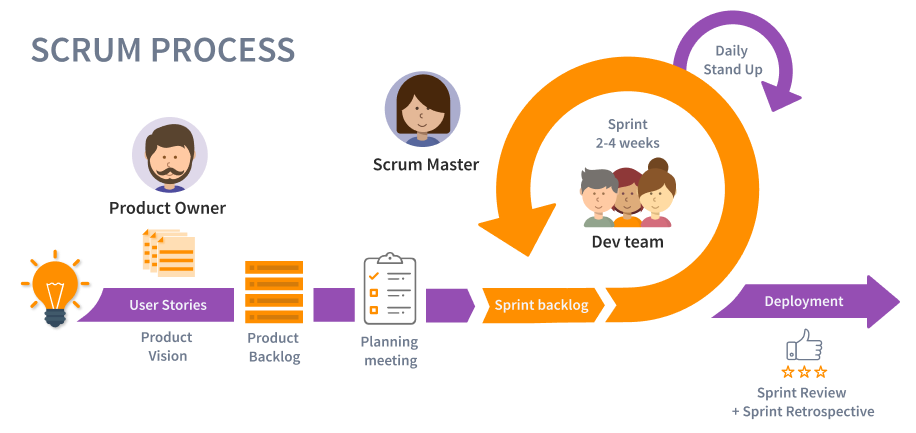
What would your work look like if you really applied SCRUM effectively? In this one-on-one course, you’ll discover how to gain better control over projects, achieve results faster, and collaborate smoothly within an agile team. With personalized guidance, interactive online modules, and hands-on assignments, you’ll learn to apply SCRUM in a way that has an immediate impact on your work.
SCRUM
SCRUM is an AGILE methodology that helps teams collaborate effectively and flexibly on projects. Instead of following a rigid, predefined plan, SCRUM involves working in short, well-defined work periods called sprints. At the end of each sprint, you deliver a concrete and usable result. This allows you to respond more quickly to changes and continuously improve your process and product.
A Scrum team consists of three distinct roles: the Product Owner, the Scrum Master,and the development team. Each role contributes to a smooth-running project. The Product Owner oversees priorities, the SCRUM Master facilitates the process, and the team carries out the work. This clear division of tasks fosters structure, ownership, and a high degree of collaboration.
SCRUM is now widely applicable: from IT and software development to marketing, education, and geospatial projects. It is a proven approach for organizations that want to be agile, achieve results quickly, and continuously improve their processes.
What will you learn in this Blended Learning course?
In this course, you’ll learn how to apply SCRUM to collaborate more effectively, achieve results faster, and gain better control over your projects. You’ll be introduced, step by step, to the key elements of SCRUM, such as sprint planning, retrospectives, daily stand-ups,and managing the product backlog.
You’ll also discover how the three core roles within SCRUM work together:
Product Owner – sets priorities and maximizes the value of the team’s deliverables;
Scrum Master – facilitates the process, supports the team, and removes obstacles;
Development Team – works independently on solutions and delivers a working result after each sprint.
Does this blended-learning SCRUM course also cover GIS? Yes! During the course, you’ll work with real-world examples from the field of GIS system development. SCRUM is therefore not only explained theoretically but also applied in realistic situations within Geographic Information Systems (GIS). This allows you to experience how SCRUM works in projects involving geodata or geospatial software.
This course is designed for professionals who truly want to understand and apply SCRUM in their daily work. Whether you work in IT, urban planning, geospatial applications,or any other sector where agile methodologies are valuable—you’ll learn how to effectively apply SCRUM in your practice.
Why choose this “Working with SCRUM” course?
The “Working with SCRUM” blended learning program combines independent online study with hands-on, interactive sessions. This allows you to develop both theoretical knowledge and practical experience with agile working and the SCRUM methodology. The online modules give you the freedom to study at your own pace. They include interactive lessons on topics such as sprint planning, creating and managing the product backlog, conducting daily stand-ups, and guiding a project from concept to a working solution.
During the hands-on online sessions, you’ll immediately apply the knowledge you’ve gained. You’ll work with realistic real-world cases, including examples from the field of geodata and geospatial system development. Under the guidance of experienced SCRUM coaches, you’ll practice applying SCRUM in a team environment. This way, you’ll learn how to collaborate effectively, identify and resolve obstacles, and continuously deliver value in short, manageable cycles.
This combination of flexible online learning and hands-on application ensures that you not only understand what SCRUM is but also how to apply it to real-world projects. Upon completion of the course, you’ll have concrete skills that are immediately applicable in sectors such as IT, geoinformation, software development, and project management. This will enable you to adapt more quickly, collaborate more effectively, and achieve better results.
You'll receive personalized guidance. After you register, our course coordinator will contact you to schedule your first session.
Learning Objectives
After completing this course, you will be able to:
Use Scrum roles to collaborate more effectively in agile teams;
Plan, execute, and evaluate sprints to deliver projects step by step;
Manage the product backlog and set the right priorities as a Product Owner;
Use Scrum in your own work, including for projects involving geodata or geospatial software;
Apply agile working methods to achieve results faster and more efficiently;
Successfully prepare to earn a Scrum certification from Scrum.org.
Want to know more?
Do you have questions about the course content? Or are you unsure whether the course aligns with your learning goals or preferences? Would you prefer an in-company or private course? We’d be happy to help.