
Data analysis is a systematic process that involves applying statistical and mathematical techniques to understand, examine, and analyze data, and to identify patterns.
Datamanagement
Data analysis is a systematic process that involves applying statistical and mathematical techniques to understand, examine, and analyze data, and to identify patterns.
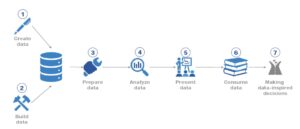
In today’s digital age, data analysis has become indispensable for businesses and organizations. It enables us to extract valuable insights from vast amounts of data, identify trends, and make predictions. These techniques range from basic statistics to complex algorithms, allowing us to dig deep into the core of data to uncover patterns and relationships. Tools like PowerBI make this process more accessible, enabling even those without in-depth statistical knowledge to perform powerful analyses. At Geo-ICT, we understand the importance of these skills in the modern world and offer a course that not only covers the theory but also provides hands-on experience with these essential tools. By combining quantitative and qualitative methods, our course prepares you to effectively use data analysis in various professional contexts, from geoinformation to business strategies, giving you a head start in your career.
To unlock the full potential of data analysis, it is crucial to understand the value and importance of data in our modern world. Data, in all its forms and sizes, has become the backbone of decision-making and innovation across countless sectors. From geoinformation to consumer behavior, data drives the development of new technologies, strategies, and solutions. Here are some key points that highlight the importance of data:
Integrating data analysis into the core of business and technological processes increases efficiency, improves the customer experience, and drives economic growth. Understanding the value of data and how to leverage it is essential for anyone who wants to succeed in today’s digital age.
Statistical and mathematical techniques form the core of effective data analysis. These methods enable us to delve deeper into data, identify patterns, and make predictions with greater accuracy. By harnessing the power of these techniques, we can:
These methods are not only crucial for analyzing geodata, but also for improving business processes, increasing customer satisfaction, and driving innovation.
The foundation of data analysis lies in understanding and applying statistics and mathematical techniques. These disciplines are essential for correctly interpreting data, recognizing patterns, and making predictions. Understanding variables, both continuous and discrete, plays a crucial role in this.
By applying these fundamentals, we can not only understand the current state of the data but also look ahead to potential future developments.
The practical application of data analysis tools such as PowerBI transforms how we interact with data, making complex datasets understandable and accessible to a broader audience. These tools enable users to:
By harnessing the power of these tools, organizations can make data-driven decisions, increase efficiency, and discover new opportunities.
Choosing our Data Analysis Course means choosing a deep understanding of data analysis and statistics, with a strong focus on practical skills. You’ll not only learn the theoretical foundations but also gain hands-on experience with leading data analysis tools such as PowerBI. Our course is unique because of:
This course is designed to teach you not only how to analyze data, but also how to apply these analyses to solve real-world problems.
On the first day, the following topics will be covered:
To clarify the theory, several exercises will be completed in PowerBI.
On the second day, the following topics will be covered:

Do you have questions about the course content? Or are you unsure whether the course aligns with your learning goals or preferences? Would you prefer an in-house or private course? We’d be happy to help.
Our Data Analysis Course offers comprehensive training in statistical analysis and the use of data analysis software such as PowerBI, designed for both beginners and experienced professionals in the geospatial sector.
This training is ideal for entry-level geospecialists, experienced geoprofessionals, companies in the geospatial sector, people seeking career transitions, and educational institutions looking to deepen or refresh their knowledge of data analysis.
Yes, in our course we cover the use of PowerBI in detail as an important tool for data analysis, suitable for a variety of applications.
Absolutely. Upon successful completion of the course, you will receive a Geo-ICT certificate that is recognized within the geospatial sector.
The course covers various techniques, such as linear regression analysis and hypothesis testing, which are essential for effective data analysis.
Certainly, our course is highly relevant for data engineers who want to expand their skills in statistics and data analysis.
The Data Analysis course lasts 2 days and costs €1,095, excluding VAT.
