In this article, you’ll learn everything there is to know about GPS, the technology that has transformed our daily lives. From the basics and how it works to its advanced applications across various industries, we’ll take an in-depth look at the fascinating world of the Global Positioning System.
In a sense, everyone knows what GPS is. It’s in our cell phones, our cars, and other devices. Professionals such as surveyors also use it frequently. When applying GPS in surveying, the accuracy requirements are somewhat higher. A GPS receiver for surveying applications must be able to determine a location with centimeter-level accuracy. This allows the X, Y, and Z coordinates of a point to be determined very precisely in the field.
In this blog, I want to take a layperson’s look at what GPS actually is and what lies behind it. Imagine standing in the middle of an unfamiliar city, with only your smartphone in hand, and within seconds knowing exactly where you are, how to get to your favorite café, or even the distance to your next destination.
That’s quite common nowadays, but a few decades ago it was almost unthinkable.
Thanks to GPS, a marvel of modern science and engineering, this is now a reality for millions of people around the world. GPS, or the Global Positioning System, is not just a navigation tool; it has become an essential part of our daily lives, from planning trips, tracking and tracing objects, to improving business operations.
GPS, originally designed for military use, has evolved over the years into a civilian application that offers us unprecedented freedom and security. Through a network of satellites orbiting our planet, GPS enables us to obtain precise location, time, and speed information, no matter where we are on Earth.
But how does GPS actually work? And how has it evolved so rapidly from a military tool to an indispensable part of our daily lives? In this article, we dive deep into the fascinating world of GPS. We’ll explore the basic technology behind GPS, how it works, and, more importantly, how it’s used in all kinds of aspects of our lives. From simply finding your way in a foreign city to tracking expeditions in the most remote areas of the world, GPS plays a crucial role.
Furthermore, we’ll look at the applications of GPS in daily life, in business, and in science. Whether it’s improving the efficiency of delivery services, supporting researchers in collecting data in the field, or providing safety through real-time tracking, GPS has proven to be a versatile and valuable tool.
Today, GPS technology is integrated into nearly every device we use, from smartphones and watches to cars and drones. This integration has sparked a new wave of innovation and convenience, enriching our lives in ways we could not have previously imagined.
So, whether you’re interested in how GPS works technically, how you can use it to improve your daily life, or are simply curious about its various applications, you’ve come to the right place. Let’s explore GPS together.
GPS stands for Global Positioning System and is a network of approximately 30 satellites orbiting the Earth. It was established and is managed by the U.S. Department of Defense, but the great thing is that it is accessible to everyone, anywhere in the world, free of charge. These satellites continuously transmit signals that can be picked up by a GPS receiver, such as the one in your smartphone or your car navigation system. It is this technology that allows you to determine your exact location on Earth, accurate to within a few meters.
But how exactly does GPS work? Let’s not overcomplicate it: each satellite sends information about its location and the current time to Earth. A GPS receiver detects these signals from multiple satellites simultaneously and uses this information to calculate your exact position through a process called trilateration. Imagine you’re standing in an open field and you hear a cow mooing. You don’t know exactly where the cow is, but if you hear the sound from three different directions, you can determine its location with reasonable accuracy. GPS works on a similar principle, but with signals from space.
The beauty of GPS lies in its versatility. Not only can it determine your location and speed, but it can also be used for highly accurate time measurements. This aspect of GPS is crucial for things like synchronizing time across mobile communication networks, financial transactions, and even managing energy grids.
One of the most amazing things about GPS is that it works everywhere, 24 hours a day, in all weather conditions, without subscription fees or installation costs. It has become an essential part of our modern infrastructure, comparable to electricity or the internet. Whether you’re hiking deep in the woods, sailing the oceans, or simply navigating through the city, GPS is your invisible guide, always ready to help.
Understanding GPS and how it works opens up a world of possibilities. It has not only changed the way we navigate, but it has also opened new avenues for innovation, from agriculture to aviation, and from logistics to personal fitness. In the following sections, we’ll delve deeper into how GPS impacts our daily lives and what new developments we can expect in the future.
Now that you have a basic understanding of what GPS is and how it works, let’s dive deeper into the technology behind this incredible system. The heart of GPS lies in a concept known as trilateration, a method for determining the position of a point by measuring the distances from that point to at least three known points. In the case of GPS, these known points are the satellites orbiting the Earth.
Each GPS satellite continuously transmits a signal containing information about its position and the exact time of transmission. When your GPS receiver receives this signal, it can measure the time it took for the signal to travel from the satellite to the receiver. Because radio signals travel at a constant speed, the receiver can use this time measurement to calculate the distance to the satellite. By repeating this process with signals from multiple satellites, the receiver can determine its own three-dimensional position (latitude, longitude, and altitude) on Earth.
But the technology behind GPS goes beyond trilateration alone. The system must also account for various factors that can affect the accuracy of position determination. One of these factors is ionospheric delay, in which the GPS signal slows down as it travels through Earth’s ionosphere. GPS receivers use complex algorithms to correct for this and other effects, such as the relativistic time delay caused by Earth’s gravity.
Another important aspect of GPS technology is the Ground Control Network, a global network of ground stations that tracks and monitors the satellites’ orbital data. These ground stations regularly transmit updated orbital information and system corrections to the satellites, which in turn relay this information to GPS receivers. This ensures that the location data you receive is as accurate as possible.
GPS technology also utilizes a principle called Selective Availability (SA), which previously limited the accuracy of civilian GPS signals for security reasons. Fortunately, SA was disabled in 2000, significantly improving the accuracy of GPS for civilian use. Today, GPS receivers can determine locations with an accuracy of just a few meters, and with additional techniques such as Differential GPS (DGPS), this accuracy can be improved even further.
The development of GPS is a story of technological innovation and collaboration. From the first satellite launches to the advanced algorithms used in the receivers, every aspect of GPS reflects humanity’s drive for discovery and improvement. It is a system that not only helps us find our way in the world but has also deepened our understanding of time and space. By understanding the technology behind GPS, we appreciate all the more how this system enriches our lives in countless ways.
Now that we’ve unpacked the technology behind GPS, it’s time to shine a spotlight on the GPS devices and software that bring this technology to life in our daily lives. GPS devices come in all shapes and sizes, from the navigation systems in your car to the sports watches on your wrist and the smartphones in your pocket. Each of these devices uses GPS technology to determine your location, but they do so in unique ways tailored to their specific use.
Navigation systems, for example, are designed to guide you from point A to point B with real-time route guidance, traffic updates, and detour information. These systems rely not only on GPS but also on detailed map data and software that is constantly updated to provide the most accurate and efficient routes.
Sports watches and fitness trackers go a step further by not only tracking your location but also monitoring your movements, speed, and even your heart rate. These devices have become indispensable for runners, cyclists, and hikers who want to measure their performance and track their progress. The software behind these devices analyzes the collected data and provides insights that can help you achieve your fitness goals.
In the world of smartphones, GPS has revolutionized the way we communicate, navigate, and even how we play games. Apps like Google Maps and Waze use GPS to provide real-time navigation, while other apps, such as geocaching games or fitness apps, use GPS to create an interactive experience that connects the physical and digital worlds.
But it’s not just the hardware that matters; the software behind these devices plays a crucial role. Developers around the world are constantly working to improve GPS software, making it faster, more accurate, and more reliable. Updates to software algorithms can bring significant improvements to how signals are processed and interpreted, leading to better user experiences.
Furthermore, the integration of GPS technology with other technologies, such as augmented reality (AR) and machine learning, is driving the development of innovative applications that are transforming how we interact with the world around us. Think of apps that can display the starry sky in real time based on your location, or systems that analyze traffic flows to improve the efficiency of urban planning.
These devices and software highlight the versatility and adaptability of GPS technology. They illustrate how a system, once designed for navigation, has evolved into an integral part of our modern lifestyle, offering innovation and convenience in ways we could scarcely have imagined. As we move forward, the future of GPS devices and software remains undoubtedly exciting, with the promise of even more advanced and innovative applications waiting to be discovered.
After exploring the technology behind GPS and the various devices and software that support it, let’s take a look at how GPS affects our daily lives. It’s truly amazing how a technology originally developed for navigation and positioning has become such an integral part of our daily lives. From finding the fastest route to work to tracking your run, GPS makes it all possible.
Imagine going on vacation to an unfamiliar city. With GPS at your fingertips, navigating becomes a breeze. You can find restaurants, museums, and attractions without ever getting lost. And it’s not just about navigation; GPS also helps enrich your travel experience by providing recommendations and reviews of nearby places.
In the world of sports, GPS has revolutionized the way athletes track their workouts. Sports watches and fitness apps use GPS to measure your speed, distance, and route. This allows athletes to accurately analyze their performance and make targeted improvements to their training schedules.
GPS also plays a crucial role in business operations. Companies that rely on logistics and delivery services use GPS to track their vehicles, plan efficient routes, and provide real-time updates to their customers. This application of GPS not only increases efficiency but also improves customer satisfaction by ensuring accurate delivery times.
But GPS does more than just help us with navigation and sports; it also plays a vital role in safety and emergency services. Many modern cars are equipped with GPS-based systems that can alert emergency services in the event of an accident. Additionally, rescue teams use GPS to locate missing persons more quickly and efficiently.
One of the most exciting developments is the integration of GPS into social media and games. Apps like Pokémon GO have demonstrated how location-based games can change the way we interact with our surroundings and with each other. These games encourage people to go outside, explore new places, and even make new friends.
GPS has profoundly changed our lives. It not only offers convenience and efficiency but also opens the door to new adventures and discoveries. The possibilities of GPS are nearly limitless, and as the technology continues to evolve, we will undoubtedly see even more innovative and exciting applications that enrich our daily lives. The impact of GPS extends far beyond simple navigation; it has transformed the way we experience and understand the world.
In today’s digital age, GPS plays a key role in the development and implementation of modern technologies. It is fascinating to see how this technology, which was once intended solely for positioning and navigation, is now fundamentally embedded in nearly every technological innovation we use daily. From smartphones and smartwatches to drones and self-driving cars, GPS is the invisible force that makes these devices smarter, more efficient, and more autonomous.
In the world of mobile communications, GPS has contributed to the development of location-based services that we take for granted. Apps that show you the nearest restaurants, gas stations, or hotels rely on GPS data to provide you with real-time, personalized recommendations. But it goes beyond mere convenience; GPS also enables emergency services to locate callers more quickly, which can be crucial in life-threatening situations.
Augmented reality (AR) is another area where GPS plays a crucial role. By overlaying the physical world with digital information, AR applications create unique experiences that transform how we interact with the world around us. GPS data is essential for accurately positioning digital objects in the real world, enabling applications like Pokémon GO, which has brought millions of users outside to catch “virtual creatures” in their own city or neighborhood.
In the automotive industry, GPS is the backbone of navigation systems that help drivers reach their destination via the most efficient route. Additionally, it is a crucial component in the development of self-driving cars, where GPS data is combined with sensors and cameras to guide vehicles safely and accurately through traffic.
Drones use GPS for a variety of purposes, from aerial photography and map creation to precision agriculture and infrastructure inspections. By knowing exactly where they are, drones can perform their tasks autonomously, with minimal human intervention.
Perhaps one of the most impactful applications of GPS in modern technology is in environmental monitoring and climate research. Scientists use GPS data to monitor changes in the Earth’s surface, which is essential for understanding climate change, tracking the melting of ice caps, and observing changes in sea levels.
The role of GPS in modern technologies is thus multifaceted and profound. It not only makes our daily lives easier and more efficient, but it also contributes to important scientific discoveries and innovations that can shape the future of our planet. As the technology continues to evolve, the applications of GPS will undoubtedly continue to expand, creating new possibilities that we may not even be able to imagine today. GPS is truly a cornerstone of modern technological progress, an invisible yet indispensable tool that continues to push the boundaries of what is possible.
In addition to its ubiquitous presence in our daily lives, GPS also plays a crucial role in business and scientific research. In the business world, GPS technology has fundamentally transformed the way companies operate by increasing efficiency, reducing costs, and improving the customer experience. Logistics companies rely on GPS for real-time tracking of goods, allowing them to provide more accurate delivery times and ensure the safety of their cargo. Fleet management is another area where GPS has become indispensable, enabling companies to manage their vehicles more efficiently, reduce fuel consumption, and improve driver safety.
In the realm of scientific research, GPS opens doors to new discoveries and insights. Researchers use GPS technology for a wide range of applications, from tracking animal migration patterns to monitoring climate change by measuring shifts in the Earth’s surface. Geologists use GPS to monitor tectonic movements, which is crucial for predicting earthquakes and studying the Earth’s dynamics.
One of the most innovative applications of GPS in the business world is in agriculture. Precision agriculture, a practice that uses GPS technology to optimize variables such as seeding density, pesticide use, and harvest times, has increased efficiency and reduced environmental impact. Farmers can use GPS to accurately map their fields, monitor crop health, and allocate resources more efficiently, leading to higher yields and lower costs.
Urban planning and development also benefit from GPS technology. Urban planners use GPS data to analyze traffic flows, optimize public transportation systems, and plan urban expansion. These applications of GPS contribute to the creation of smarter, more efficient, and more sustainable cities.
In healthcare, GPS is used to improve emergency response services, enabling ambulance and rescue teams to locate patients more quickly. This can be lifesaving, especially in remote or hard-to-reach areas.
The impact of GPS in business and research is profound and multifaceted. It not only improves operational efficiency and customer satisfaction across various industries, but it also enables us to better understand our world and the universe beyond. GPS is a powerful tool that, when used wisely, can help solve some of the most challenging problems of our time, from climate change to urban development and everything in between. As we look ahead, it is clear that the possibilities for future applications of GPS in both business and research will only continue to grow.
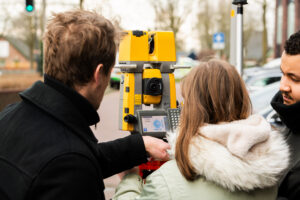
As mentioned earlier, GPS also plays an important role in surveying. When applying GPS in surveying, higher accuracy requirements are imposed. A GPS receiver for surveying applications must be able to determine a location with centimeter-level accuracy. You can learn more about this in our surveying course. In this course, you’ll gain insight into and an overview of how surveying works. You’ll also go out into the field to take measurements using a GPS and a Total Station.
While we explore the current applications of GPS in our daily lives and in the world of modern technologies, it is equally important to look ahead to the innovations and future of this indispensable technology. The future of GPS looks incredibly promising, with developments that will further transform our lives and the way we interact with the world around us.
One of the most exciting prospects is the improvement in the accuracy of GPS technology. Scientists and engineers are working on new methods and technologies, such as next-generation GPS satellites and ground systems, that will bring location accuracy down to the centimeter. These improvements will not only enhance the user experience for consumers but also open up new possibilities in advanced scientific research and commercial applications.
Spatial intelligence is another area where we can expect significant innovations. By combining GPS with artificial intelligence (AI) and machine learning, we can develop systems that not only know our location but also understand what is happening in our surroundings. These technologies can, for example, be used to make autonomous vehicles smarter by enabling them to predict traffic patterns, avoid obstacles, and even respond to unforeseen circumstances.
In agriculture, the future of GPS will lead to even greater precision in precision farming, enabling farmers to manage resources more efficiently, maximize yields, and minimize environmental impact. By integrating GPS technology with sensors in the field and drones in the air, farmers can obtain real-time data on the condition of their crops and soil, leading to more informed decision-making.
Another exciting prospect is the integration of GPS with personal health and wellness technologies. Wearables that use GPS can not only track activities and movements but also provide insights into users’ health and well-being, for example by monitoring air quality in their surroundings or the amount of sunlight exposure.
Finally, the future of GPS in urban planning and management also looks promising. GPS data can help urban planners design smarter cities, with more efficient traffic flows, better public services, and a higher quality of life for their residents.
Innovations in GPS technology will continue to amaze us and offer unprecedented potential to improve our society. From creating safer and more efficient transportation systems to supporting sustainable agricultural practices and improving public health, the future of GPS is inextricably linked to the progress of our world. As we look ahead, it is clear that GPS will continue to play a key role in shaping our technological and societal future.
After our in-depth exploration of GPS and its many facets—from the underlying technology and everyday applications to its impact on business operations and scientific research, as well as the exciting innovations on the horizon—it is clear that GPS is much more than just a navigation tool. It has become an integral part of modern society, fundamentally transforming the way we live, work, and play.
GPS has enabled us to explore and understand our world with a new level of precision. It has helped us be more efficient in our daily lives, provides safety and security in our travels, and plays a crucial role in the advancement of scientific knowledge. The technological innovations that GPS has spawned—from improved positioning to integration with other advanced technologies such as AI and AR—are opening new horizons for what is possible.
The future of GPS promises even more exciting developments. With ongoing improvements in accuracy, speed, and reliability, along with integration into new application areas, GPS will continue to contribute to significant advancements across numerous sectors, from transportation and logistics to environmental sciences and urban planning. The potential for personal health and well-being, as well as for the further development of smart cities, is enormous.
The impact of GPS extends across the globe, and its value goes beyond mere technological innovation; it contributes to enhancing the human experience and solving complex societal challenges. As we look ahead, it is clear that the role of GPS in our society will only grow, and with this growth, the opportunities for improvement and innovation will also increase.
At its core, GPS is not merely a story of technological achievement; it is a story of human ingenuity and the boundless possibilities of collaboration between technology and society. It is a powerful example of how visionary ideas and determination can change the world, and a reminder that, in a world that is constantly in motion, the direction we choose and the tools we use to chart our course are of immeasurable importance. So let’s embrace the future with open arms, motivated by the knowledge that technologies like GPS will continue to guide us toward new discoveries, improved quality of life, and a brighter future for us all.
Do you already have knowledge of GPS and want to further develop your skills? Then take our Advanced GPS course to learn how to work with precise GPS receivers and advanced techniques.