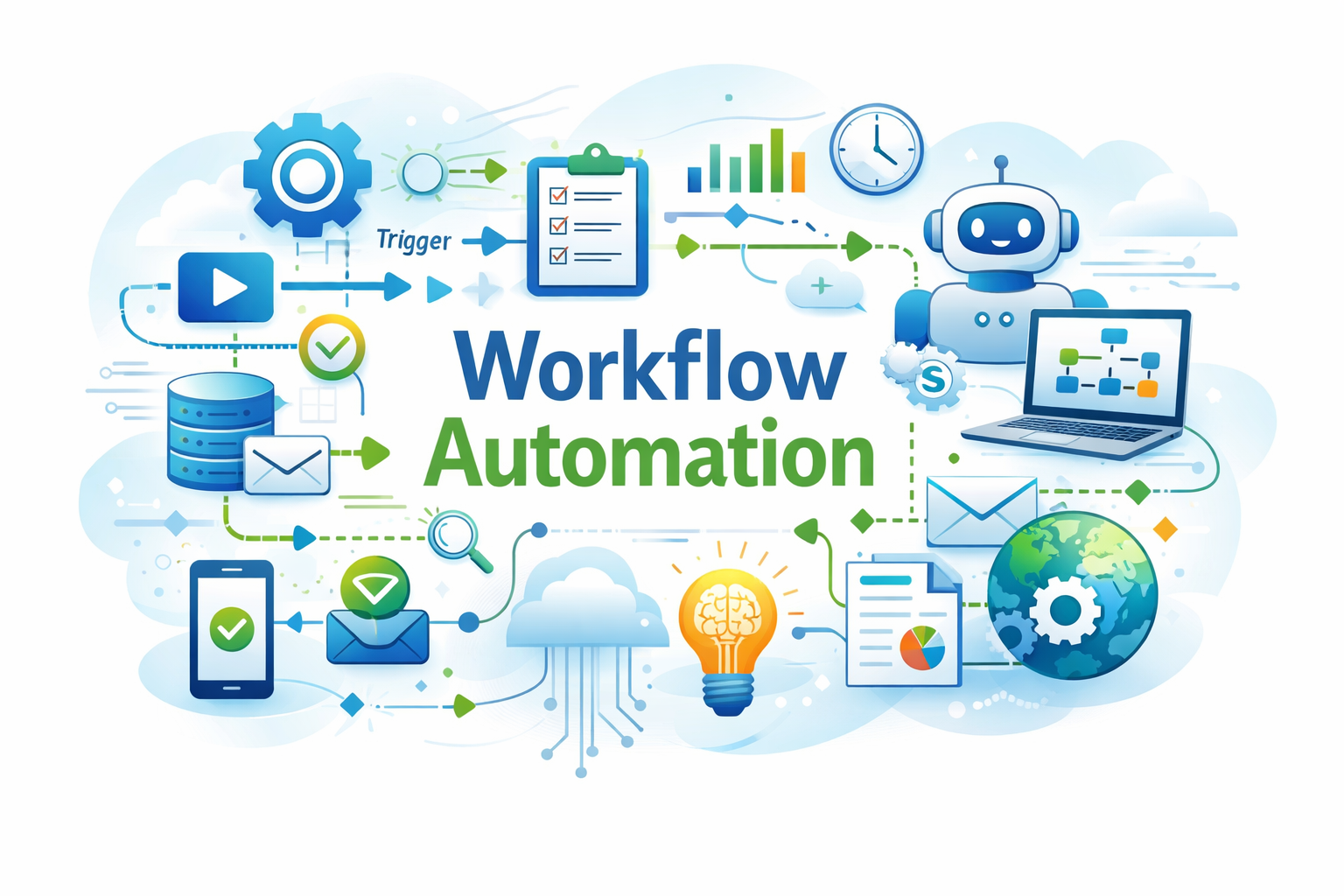
At Geo-ICT, we understand that workflow automation is playing an increasingly important role within organizations that want to work more efficiently and design smarter digital processes. That’s why we offer specialized courses in workflow automation, where you’ll learn how systems, applications, and data sources can automatically work together. In these courses, you’ll discover how to automate repetitive tasks, streamline processes, and better manage data flows using modern automation platforms.
Our approach is hands-on. You’ll work with realistic examples and learn how to build workflows using triggers, actions, filters, logic, and integrations between different systems. This way, you’ll develop skills that are immediately applicable within your own organization or project environment. By delving into workflow automation, you’ll take an important step in your professional development within the rapidly growing field of digital automation and AI-powered processes.
How workflow automation can strengthen organizations
In organizations where many systems, applications, and data flows converge, it is essential to ensure processes run efficiently and reliably. Workflow automation makes this possible by replacing manual steps with smart, automated processes. By allowing data to move automatically between systems, you achieve greater speed, reduced error rates, and more room for analysis and innovation.
Some applications of workflow automation include:
- Process automation: Repetitive tasks such as notifications, data processing, and synchronization between systems can be performed automatically.
- System integration: Different applications and data sources can be connected so that information is exchanged automatically.
- Data-driven workflows: Processes can respond to events, inputs, or changes in data, making workflows dynamic and scalable.
By using workflow automation, organizations can:
- Reduce manual work and accelerate processes.
- Limit errors in repetitive tasks.
- Gain greater control over digital processes and data flows.
Effectively implementing workflow automation requires knowledge of tools, logic, integrations, and data processing. With the right skills, organizations can design their processes more intelligently and better adapt to further digitalization.
The technology behind workflow automation
The technology behind workflow automation is based on platforms that allow digital processes to be designed visually and logically. Triggers, actions, routers, filters, and API integrations form the foundation. By combining these elements, organizations can build complete workflows that independently perform tasks and transfer information between systems.
Some key technological components include:
- Triggers and actions: Workflows start automatically based on an event and then execute predefined steps.
- API integrations: External systems and services can communicate with each other via APIs, allowing data to be automatically retrieved, processed, and sent.
- Logic and data transformation: Filters, conditions, and operations make it possible to process data in a targeted manner within complex processes.
In addition, modern automation platforms also play an important role. At Geo-ICT, you can delve into this topic with the Make Automation course, the n8n course, the Zapier course, and the Lovion Automation course. Each of our courses demonstrates a unique approach to workflow automation, ranging from accessible no-code automation to more advanced technical workflows and API integrations.
By combining these technologies, organizations can:
- Make processes scalable and reproducible.
- Efficiently connect applications, data, and tasks.
- Lay a solid foundation for further automation and AI-powered workflows.
The power of workflow automation lies in effectively combining systems, data, and process logic. With the right knowledge and tools, organizations can organize digital processes more intelligently and be better prepared for a future where automation and AI play an increasingly central role.
With Geo-ICT’s workflow automation courses, you’ll develop the knowledge and skills to effectively apply these technologies. This will help you lay a solid foundation for designing, building, and managing modern digital workflows within your organization.