First, by grouping data and the functions that manipulate that data within the same unit—known as an object—OOP offers a powerful way to organize software. This not only leads to better code reusability but also to easier maintenance and scalability.
Learning C# within the context of OOP provides a deep understanding of how modern software development works. C# offers a solid foundation for building robust and scalable applications. It is therefore not surprising that many data-driven applications and software we use daily are built using the principles of OOP and the flexibility of C#.
The Importance of Object-Oriented Programming
Why do we place so much emphasis on OOP when discussing modern software development? OOP is not just a programming style. It is a foundation that transforms the way we think about and build software. Let’s take a look at some of the key benefits OOP offers:
- Modularity: By organizing code around objects, each component of an application can be viewed and managed as a separate unit.
- Reusability: OOP encourages code reuse. Once created, classes and objects can be used across different projects. This saves time and increases consistency.
- Flexibility through polymorphism: Polymorphism allows the same function to operate in different ways depending on the object that calls it. This adds a layer of flexibility to your applications that is difficult to achieve with other programming paradigms.
- Security through encapsulation: By encapsulating data and methods within objects, OOP protects sensitive data and reduces the likelihood of errors in the code.
But it’s not just about the technical advantages. Object-oriented programming also aligns with the way we think about the world—namely, as a collection of objects that interact with one another. This makes OOP not only powerful in terms of software development but also intuitive for new programmers.
For C# in particular, OOP is crucial because it forms the foundation upon which the language is built. C# was designed with the .NET framework in mind, a platform that relies heavily on OOP concepts for creating both simple and complex applications. Whether you’re working on a small personal project or a large, data-intensive application in the world of geoinformation, the principles of OOP provide a solid foundation for your work.
The Unique Features of C#
C# is a powerful, object-oriented programming language developed by Microsoft. And it has transformed the world of software development since its introduction. But what really makes C# unique, and why would you want to learn this language in particular? Let’s dive into some of the distinctive features that make C# so appealing to developers:
- Type Safety: C# was designed with a strong focus on type safety. This means the language ensures you don’t accidentally store one type of data in a variable of another type.
- Memory Management: Thanks to the .NET framework, of which C# is an integral part, memory is managed automatically. This means developers have less to worry about when it comes to freeing up memory and preventing memory leaks.
- Modern Syntax: C# has a clean, modern syntax that makes it easy to read and write.
- Versatility: With C#, you can develop a wide range of applications, from simple desktop applications to complex web services and mobile apps. This versatility makes it an excellent choice for developers who want to work across different domains.
Some specific advantages of C# in the context of geoinformation and geodata include:
- Rich Library: C# provides access to an extensive library of predefined classes that simplify working with geographic data and mapping technologies.
- Support for Parallel Processing: For applications that need to process large amounts of geodata, C# offers built-in support for parallel processing. This allows tasks to be executed faster and more efficiently.
- Integration with Microsoft Technologies: For organizations already using Microsoft technologies, such as Azure for cloud computing, C# offers seamless integration.
The combination of its robust feature set, Microsoft’s support, and its vibrant community make C# an attractive choice for any developer looking for a language that is both powerful and accessible.
What You’ll Learn in the C# Programming Course
Fundamentals of C# Syntax and Data Types
At the core of every programming language lie syntax and data types, and C# is no exception. C# syntax is logically structured and designed to be both readable and simple. This allows you to quickly grasp the basics of programming in C#. As for data types, C# offers a rich collection that enables you to work with various types of data—from the simplest to the most complex. Let’s explore some of the fundamental aspects of C# syntax and data types:
Syntax
- Declarations and Assignments: Like many other programming languages, C# uses declarations to create variables and assignments to assign values to those variables. A unique feature of C# is its strong type checking. This means you must explicitly specify the variable’s type in the declaration.
- Conditions and Loops: To control the flow of your program, C# provides structures such as
if-statements, switch-cases, and loops such as for, foreach, and while. These constructs help you make decisions in your code and perform repetitive tasks efficiently.
Data Types
- Primitive Types: C# has a set of primitive types, such as
int (integers), double (double-precision floating-point numbers), char (characters), and bool (Boolean values).
- Complex Types: In addition to primitive types, C# also supports more complex data structures, such as arrays, lists, and dictionaries, as well as user-defined types via classes and objects.
Specifics of C# data types in the context of geoinformation and geodata:
- Use of `
decimal` for Geographic Coordinates: For applications that work with geographic coordinates, the decimal type in C# provides the accuracy required for such data, where precision is of critical importance.
- More Complex Structures for Geodata: Manipulating geodata often requires the use of more complex data structures, such as lists of objects representing geographic entities. C# makes it easy to create and manage such structures, which is essential for the development of GIS applications.
By understanding the basics of C# syntax and data types, you lay a solid foundation for your continued growth as a software developer. This knowledge enables you to confidently begin building applications in C#—from simple command-line tools to complex systems that work with geoinformation. It is this blend of accessibility and depth that makes C# so appealing to both beginners and experienced programmers.
Mastering variables, conditions, and loops
After laying a solid foundation with the basics of C# syntax and data types, it’s time to take your skills to the next level by mastering variables, conditions, and loops. These concepts are essential for every programmer, as they form the basis for developing logic within applications. Let’s take a closer look at how these concepts are used in C# and why they are so important.
- Variables in C# are containers for storing data values. When declaring variables, it is important to choose the correct data type to clarify the intent of the code and to optimize memory usage.
- Conditions allow you to make decisions in your code. By using
if, else if, and else statements, you can determine different executions of code blocks based on whether certain conditions are met.
- Loops are structures that allow a block of code to be repeated as long as a certain condition is met. In C#, there are several types of loops, including:
for loops, perfect for situations where you know how many times a block of code needs to be executed.while and do-while loops, ideal for executing a block of code as long as a certain condition is met, where the number of iterations is not known in advance.
By understanding and effectively applying these concepts, you can create complex logic in your programs. It enables you to respond to user input, process data, and automate tasks within your geoinformation applications. For example:
- Use variables to store and manipulate geodata.
- Apply conditions to determine how your application responds to different geographic scenarios.
- Implement loops to iterate through datasets and perform calculations or transformations.
Advanced C#-specific concepts and user interfaces
As you delve deeper into the world of C# programming, you’ll discover a range of advanced concepts that set the language apart and can take your applications to the next level. Let’s explore some of these concepts, as well as how C# enables you to build intuitive user interfaces:
- LINQ (Language Integrated Query): LINQ is a revolutionary addition to C# that integrates query capabilities directly into the language. It allows you to write powerful and expressive queries for manipulating data, regardless of the source (such as arrays, SQL databases, or XML documents). This makes working with data significantly easier and more intuitive.
- Asynchronous programming: With C#’s support for asynchronous programming, you can develop applications that handle I/O operations and long-running tasks more efficiently. This results in a more responsive user experience. Asynchronous methods help keep the UI thread free and prevent your application from “freezing” while performing long-running operations.
- User interface development: With frameworks such as Windows Presentation Foundation (WPF) and Universal Windows Platform (UWP), C# offers powerful tools for designing rich, interactive user interfaces. These frameworks support:
- Data binding, allowing you to directly link UI components to data sources.
- Templates and styles, to easily and consistently customize the look and feel of your application.
- A comprehensive event system, allowing your application to dynamically respond to user actions.
By combining the power of LINQ with asynchronous programming and advanced UI development, you can solve complex problems while delivering a seamless experience to your users. These aspects of C# make it an excellent choice for developers aiming to create modern, robust, and scalable applications in the field of geodata and beyond.
Why Choose Our C# Programming Course?
When choosing a C# Programming course, many factors come into play. However, our course stands out in several ways, making it not only an educational but also a unique experience. Here are a few reasons why our course is the right choice for anyone who wants to delve into the world of C# and software development:
- In-Depth Knowledge and Practical Experience: Our course is designed by experienced developers with a deep understanding of C# and a passion for teaching.
- Personalized Guidance: We understand that everyone learns at their own pace. That’s why we offer personalized guidance to all students. Whether you’re stuck on a complex problem or need extra clarification on a specific concept, our instructors are ready to help.
- Hands-On Projects: Theory is important, but practical experience is essential. Our course includes various hands-on projects that challenge you to apply what you’ve learned.
- Flexibility: We understand that not everyone has the same schedule. Our course offers the flexibility you need to learn in a way that suits you, without compromising your current commitments.
- Access to the Latest Technologies: The world of technology is constantly evolving. That’s why we ensure our course is always up-to-date with the latest developments and technologies within C# and the .NET framework. This way, you’re always prepared for the future.
Choosing our C# Programming Course means choosing a course that not only strengthens your technical skills but also prepares you for a successful career in software development. Whether you’re interested in geoinformation, building web applications, or developing desktop software, our course provides a solid foundation on which you can build.

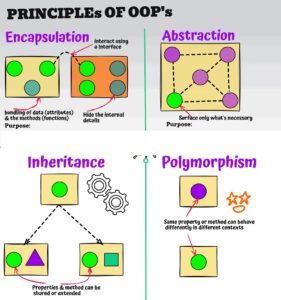 In the world of software development, object-oriented programming (OOP) is a paradigm that has become indispensable. It differs fundamentally from procedural programming in that it uses objects instead of actions and data instead of logic. But what makes OOP so unique and valuable, especially for a language like C#?