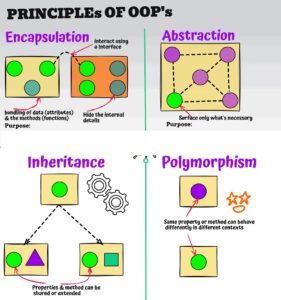
The flexibility of C++ extends to memory management. As a developer, you have direct control over both static and dynamic memory allocation. This contributes to optimizing application performance. Furthermore, C++ allows you to explore advanced concepts such as inheritance, polymorphism, function overloading, and exception handling, enabling you to write robust and maintainable code.
Geo-ICT offers you the opportunity not only to learn the theoretical foundations of C++ but also to gain hands-on experience through practical projects. Whether you’re interested in geodata processing or developing geographic information systems. The C++ course at Geo-ICT prepares you for the challenges of modern software development. Through our focus on the practical application of C++ in the context of geoinformation technology, you will discover how to use this programming language to create advanced and efficient solutions.
The Evolution of C++: From C to the Present
C++ has a rich history dating back to the 1970s, when it was developed by Bjarne Stroustrup as an extension of the C programming language. This language was initially called "C with Classes." It was intended to enable programmers to design complex systems in a more organized manner. Over the years, C++ has evolved into one of the most widely used programming languages in the world, and for good reason. Here are some highlights in the evolution of C++:
- The introduction of object-oriented programming (OOP), which made code reusable and easier to maintain.
- The standardization of the language in 1998 (and subsequent updates), which brought greater uniformity to the way programmers write and understand C++ code.
- The addition of the Standard Template Library (STL), which offers a rich set of algorithms and containers.
Some key moments in the evolution of C++ are:
- Late 1970s: Development of "C with Classes"
- 1983: Renamed to C++
- 1998: First official standardization of C++ (ISO/IEC 14882:1998)
- 2011: Major update with C++11, which introduced modern features such as lambda expressions and smart pointers.
The strength of C++ lies in its flexibility and the breadth of its applications. From developing operating systems to creating high-performance applications such as games or server applications. Geo-ICT leverages this versatility by offering courses that not only cover the basics of C++ but also introduce you to advanced concepts and techniques.
What makes C++ special is not just its historical significance, but also how it continues to evolve to meet the contemporary needs of programmers and developers. With each new version, the possibilities are expanded, while the core principles that make C++ so powerful are preserved.
Key Features of C++ and Their Applications
When you delve into the world of C++, you’re diving into a programming language that is both powerful and flexible. C++ is known for its versatility and efficiency, qualities that make it a favorite choice for software development across various fields. Let’s explore some of the most impactful features and their applications:
- Object-Oriented Programming (OOP): At the heart of C++ is the ability to work with objects. This means you can structure programs around objects and classes, leading to better code organization and reusability. Think of the development of complex software such as simulation programs or game engines.
- Memory Management: C++ offers extensive control over memory management. This enables developers to manage system resources efficiently—something essential for the performance of system software, embedded systems, and real-time applications.
- Standard Template Library (STL): A powerful set of tools that makes it easy to implement data structures and algorithms. This facilitates rapid development of high-performance applications that require heavy data processing, such as database management systems or financial analysis tools.
- Function Overloading and Default Parameters: These features increase the language’s flexibility and support the development of more intuitive and customizable interfaces for your software. They are particularly useful in creating libraries that can be easily used by other developers.
- Compatibility with C: One of the most valuable aspects of C++ is its backward compatibility with C. This means it is possible to seamlessly integrate and enhance existing C code with C++. This is especially important for upgrading legacy systems in sectors such as telecommunications or embedded systems.
C++ remains a fundamental pillar in the development of software that requires power and precision. As a result, your skills in this language are indispensable in today’s technological landscape.
What You’ll Learn in the C++ Programming Course
Fundamentals: Classes, Objects, and Function Overloading
In the fascinating world of C++, the concepts of classes, objects, and function overloading are not just fundamentals but the building blocks that form the backbone of object-oriented programming. These elements provide a structure that allows you, as a developer, to model and manipulate data in a way that is both powerful and intuitive. Let’s take a look at how these fundamentals contribute to developing robust and flexible software:
- Classes and Objects:
- A class serves as a blueprint for objects. It defines the properties (also known as attributes or fields) and behaviors (methods or functions) that objects of that class have in common.
- An object is an instance of a class. It is an independent entity with the defined properties and behavior. By using objects, you can mimic reality within your program. This allows you to develop software that feels natural and is easy to understand.
- Function overloading:
- This powerful feature of C++ allows you to have multiple functions with the same name but different parameters. This enhances the readability and usability of the code, as you can perform different operations under the same function name, depending on the context.
- For example, you could overload a function
print to handle different data types, such as integers, floats, and strings, each with its own implementation. This makes your code not only clean and readable but also highly adaptable.
These concepts are at the core of C++ and enable you to design complex software that is efficient, maintainable, and scalable. Whether you’re working on data analysis, game development, or creating business systems, these fundamentals will help you build powerful and efficient solutions. By embracing these principles, you lay a solid foundation for your C++ programming skills, ready to tackle the challenges of modern software development.
Advanced Topics: Inheritance, STL, and Memory Management
Once you’ve mastered the fundamentals of C++, you’re ready to delve into the more advanced topics this language has to offer. These topics, such as inheritance, the Standard Template Library (STL), and advanced memory management, take your skills to the next level and enable you to develop complex and high-performance applications. Let’s take a closer look at each of these concepts:
- Inheritance:
- Inheritance allows classes to inherit properties and behaviors from other classes. This promotes code reuse and creates a hierarchical organization of classes.
- It makes it possible to define general functionality in a base class and specialized implementations in derived classes. Consider a base class
Voertuig with derived classes such as Auto, Fiets, and Vrachtwagen, each with their own unique properties.
- Standard Template Library (STL):
- The STL is a powerful library that provides a range of predefined classes and functions for common programming tasks, such as data structures, algorithms, and iterators.
- Examples of STL components include:
- Vector and list for dynamic arrays and linked lists.
- Map for storing key-value pairs.
- Algorithms such as sort and find for efficient data manipulation.
- Advanced Memory Management:
- A thorough understanding of memory management is essential for developing efficient C++ applications. C++ offers complete control over the allocation, use, and deallocation of memory. This is crucial for optimizing performance and preventing memory leaks.
- Proper memory management involves techniques such as dynamic memory allocation with
new and delete, and the use of smart pointers (such as std::unique_ptr and std::shared_ptr) to facilitate automatic memory management.
By delving into these advanced topics, you’ll unlock the full potential of C++ and be able to develop software that’s not only functional and reliable, but also efficient and scalable.
Why Choose Our C++ Programming Course?
At Geo-ICT, we understand that choosing a C++ programming course is an important step in your career or personal development. C++ programming is a skill that opens doors to countless opportunities—both in the world of software development and in the ever-growing need for geoinformation processing. Here are a few reasons why our course stands out:
- Experience and Expertise: Our instructors are not only experienced programmers but also experts in applying C++ within the geoinformation sector. They bring practical experience you won’t find anywhere else, teaching you how to apply this powerful programming language to real-world problems.
- Practical Approach: For us, learning by doing is central. Our course includes numerous practical assignments and projects that will help you refine your skills and prepare you for the real world. From day one, you’ll gain hands-on experience that is essential to your success.
- Flexibility and Accessibility: We understand that everyone has a different learning path. That’s why we offer flexible learning options, including online classes and access to comprehensive course materials, so you can learn in a way that best suits you.
By choosing our C++ Programming Course at Geo-ICT, you’re not just investing in learning a programming language, but also in an experience that prepares you for the future. Whether you’re interested in software development, geodata processing, or developing advanced geographic information systems, our course provides you with the knowledge, skills, and network to achieve your goals. Start your journey with Geo-ICT today and discover how far C++ can take you.