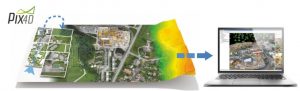
In a world where speed and accuracy are crucial, drone surveying offers unmatched efficiency by significantly accelerating surveying work while simultaneously reducing costs. At Geo-ICT, we understand the power of this technology and how it can be used to obtain accurate data that would otherwise be difficult, time-consuming, or even impossible to collect. Our Drone Survey Course is designed not only to introduce you to the fundamentals of drone flight and photogrammetry software, but also to develop your skills in collecting and analyzing geodata in a way that will shape the future of geoinformation.
The Essence of Drone Survey
At the heart of drone surveying lies a revolutionary approach to how we collect geodata and map the world around us. This technology not only transforms the world of geoinformation by offering new perspectives and possibilities, but also changes the way professionals approach and conduct surveying. By taking to the skies with drones, we unlock the potential to reach areas previously considered inaccessible or too risky. It is this flexibility and accessibility that makes drone surveying so appealing for a wide range of applications. From mapping vast agricultural lands to accurately inspecting infrastructure, the possibilities are endless.
At Geo-ICT, we emphasize the importance of understanding these essential principles and applying them effectively to obtain accurate and reliable data. Our course offers not only an in-depth look at the operational aspects of drone flights, but also at how this technology can be used to solve complex geographic challenges.
Benefits of Drone Surveying
The rise of drone surveying has opened up a world of benefits, far surpassing traditional methods of land surveying and data collection. The most striking advantage is the unparalleled efficiency with which data is collected. Drones can fly over large areas in a short time and collect detailed geodata. As a result, projects that previously took weeks can now be completed within a few days or even hours. This speed goes hand in hand with impressive accuracy, as modern drones are equipped with advanced sensors and cameras that produce sharp, detailed images.
Another significant advantage is the accessibility of hard-to-reach locations. Drones can safely navigate areas that are dangerous or inaccessible to humans—such as steep terrain, densely vegetated areas, and urban environments. This opens the door to detailed studies and analyses across a variety of fields without compromising safety.
Moreover, the versatility of drones makes them suitable for a wide range of applications, from Earth observation and 3D scanning to the management of geospatial data. Integrating drones into daily workflows enables professionals to innovate and improve their methods, leading to better decision-making and optimized results.
What You Will Learn in the Drone Survey Pilot Course
Fundamental Principles of Drone Technology
Diving into the world of drone technology means understanding the basics that make these innovations so powerful and versatile. At Geo-ICT, we guide you through the fundamental principles essential for anyone who wants to work with drones.
- Types of Drones: There are various types of drones, each with unique capabilities and applications. From small quadcopters to larger fixed-wing drones, the choice depends on your project needs.
- Quadcopters are ideal for detailed geodata collection and aerial photography.
- Fixed-wing drones offer longer flight times and are perfect for mapping large areas.
- Flight Controllers and Navigation: Modern drones are equipped with advanced flight controllers that use GPS and other sensors to ensure precise navigation and stability during flight.
- GPS provides precise positioning, which is essential for surveying and Earth observation.
- Sensors such as gyroscopes and accelerometers help maintain the drone’s balance and proper orientation.
- Sensors and Cameras: The power of drone surveying lies in the quality of the collected data. And this depends heavily on the sensors and cameras on board.
- High-resolution cameras for sharp, detailed images.
- Multispectral sensors for environmental studies and agricultural research.
- Data Analysis Software: After collecting data, the next step is to analyze it using specific software packages.
- Photogrammetry software enables the generation of 3D models from photos.
- GIS software is used to manage and analyze geographic information. This enables informed decisions to be made based on the collected data.
Understanding these components is crucial to unlocking the full potential of drone technology and integrating it into your work. Taking this course will ensure that you become confident and proficient in applying this technology in practice.
Skills in Data Collection and Processing
The art of drone surveying goes beyond simply piloting a drone. It also encompasses the critical skills in data collection and processing required to extract valuable geospatial information.
Collecting data with drones is a process that requires care and precision. It begins with:
- Planning the Drone Flight: Before taking to the skies, you must have a clear plan.
- Determining the flight path and establishing specific waypoints.
- Choosing the right time of day for optimal lighting conditions.
- Executing the Flight: Once the drone is in the air, it is essential to:
- Monitor the flight closely and make adjustments as the situation requires.
- Ensure that all necessary areas are covered and that the data is consistent.
- Data Review: After the flight, it is time to assess the collected data.
- Verify the completeness and quality of the collected images and data.
- Ensure the data is properly organized for further analysis.
The next step, data processing, is where the magic really happens. Using specialized software, you transform raw data into usable geoinformation:
- Photogrammetry software: This allows you to create detailed 3D models and maps from the collected imagery.
- GIS software: Essential for analyzing and managing geographic data. This enables you to draw insightful conclusions and make informed decisions.
These skills are not merely technical in nature. They also require a creative approach and problem-solving ability. At Geo-ICT, we ensure that you develop a deep understanding of both the theory and practice of these processes. This enables you to fully harness the power of drone technology and deliver high-quality geo-data.
Why Choose Our Drone Survey Pilot Course?
When choosing a drone survey course, you want to be sure you’re investing in quality education. Here are a few reasons why our Drone Survey Course is the perfect choice for anyone serious about developing their skills in this exciting and rapidly growing field:
- Expert Instructors: Our course is led by experienced professionals who are active in the field. They bring a wealth of practical experience and share insights you won’t find in books.
- In-depth knowledge of drone technology and geodata collection.
- Personalized attention and guidance to optimize your learning experience.
- Practical Curriculum: We strongly believe in learning by doing. Our course includes extensive hands-on sessions in which you will:
- Learn to fly different types of drones.
- Work with the latest photogrammetry and GIS software.
- Access to State-of-the-Art Equipment: As a student, you’ll have access to the latest drones and sensors on the market. This allows you to learn with the tools you’ll use in the real world.
- Experience the latest technologies in drone surveying.
- Develop skills that are directly applicable to your work or projects.
Choosing the Drone Survey Course at Geo-ICT means investing in your future. It is a course that prepares you for the reality of working with drone technology in a variety of applications, from land surveying to Earth observation.