
As an explosives project planner, you will be responsible for planning, supervising, and monitoring projects focused on the detection of explosives within the civil engineering sector.
As an explosives project planner, you will be responsible for planning, supervising, and monitoring projects focused on the detection of explosives within the civil engineering sector.
As an Explosives Detector, you play a crucial role in the safety of construction and excavation projects. Your daily tasks are not only essential but also highly specialized. Your main task is to detect and secure unexploded ordnance, making you an indispensable link in the preparation of any project involving excavation. Here are some key activities you will be involved in:
You use advanced technologies and techniques to perform your tasks, with precision and care being paramount. The importance of your work is underscored by the need to make not only current but also future construction sites safe. Your expertise helps prevent dangerous situations and ensures that projects can proceed efficiently and safely.
The work of an Explosives Detector is vital in the construction industry and has a profound impact on both safety and economic efficiency. Here are a few reasons why this role is so crucial:
Your role as an Explosives Detector thus contributes to creating a safer, more cost-effective, and ethically responsible construction environment. This not only makes you a key figure in keeping the physical work environment safe but also raises the overall standard and quality of the construction industry.
Geo-information plays a crucial role in the work of an Explosives Detector. This technology is indispensable for accurately locating and identifying potential threats beneath the earth’s surface. Here are some key ways geo-information influences this role:
These applications of geospatial information not only improve efficiency and safety in explosive detection but also enhance the reliability of the work performed. By integrating this technology, an Explosives Detection Specialist can operate with greater confidence and precision.

Do you have questions about the course content? Or are you unsure whether the course aligns with your learning goals or preferences? Would you prefer an in-house or private course? We’d be happy to help.
The Explosives Work Planner at the Geo-ICT Training Center is well-versed in the use of AutoCAD, ArcGIS, and QGIS. These skills are developed and refined in the Netherlands, where the Geo-ICT Training Center is located. After completing the training, the work planner is assigned to various clients, where the knowledge and skills acquired are immediately applied in practice. This ensures that every work planner is not only theoretically prepared but also brings practical experience to every assignment.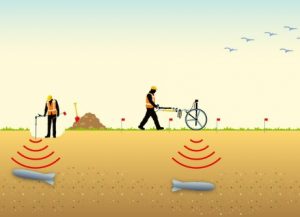
As an explosives work planner, you have a number of essential responsibilities to ensure safe and efficient operations. Here is an updated list of your key duties:
These tasks are designed to ensure that every assignment is carried out not only effectively but also safely, in strict compliance with all relevant legal requirements and safety standards.
As an Explosives Project Planner, you are responsible for preparing, overseeing, and monitoring projects focused on the detection of explosives within the civil engineering sector. This includes analyzing drawings and site conditions, drawing up work plans, coordinating resources, and collaborating with safety and field teams.
This role is vital because safe and responsible excavation or construction in areas where explosives may be present depends directly on thorough preparation and risk management. Your work helps ensure that projects proceed more quickly, safely, and efficiently.
At Geo-ICT, geospatial information plays a central role: you use GIS and mapping data, interpret historical data, and incorporate location analysis to detect explosives. As a result, the role is broader—both technologically and in terms of subject matter—than traditional job planning.
Key skills include:
A typical workday might look something like this:
Yes, Geo-ICT offers programs where you can receive training for this role and get started. Is this something for you? Then our Geo-ICT Traineeship might be just what you're looking for!
You can advance to roles such as Senior Explosives Work Planner, Explosives Detection Project Manager, or Safety & Geo-Information Specialist. By gaining additional experience, obtaining certifications (in safety, explosives, and geo-tools), and developing leadership skills, you can enhance your career prospects.
Although the primary focus of the role is on project planning and explosives management, knowledge of geoinformation (such as GIS, maps, and terrain analysis) provides clear added value in this role at Geo-ICT. It enables you to prepare projects more quickly and effectively.
You can apply directly for our Geo-ICT Traineeship or contact us via the widget on the page by entering your name, email address, and phone number to schedule a no-obligation conversation. You can also send us a WhatsApp message. If you have any questions about the program or whether the position is a good fit for you, please feel free to contact us.
