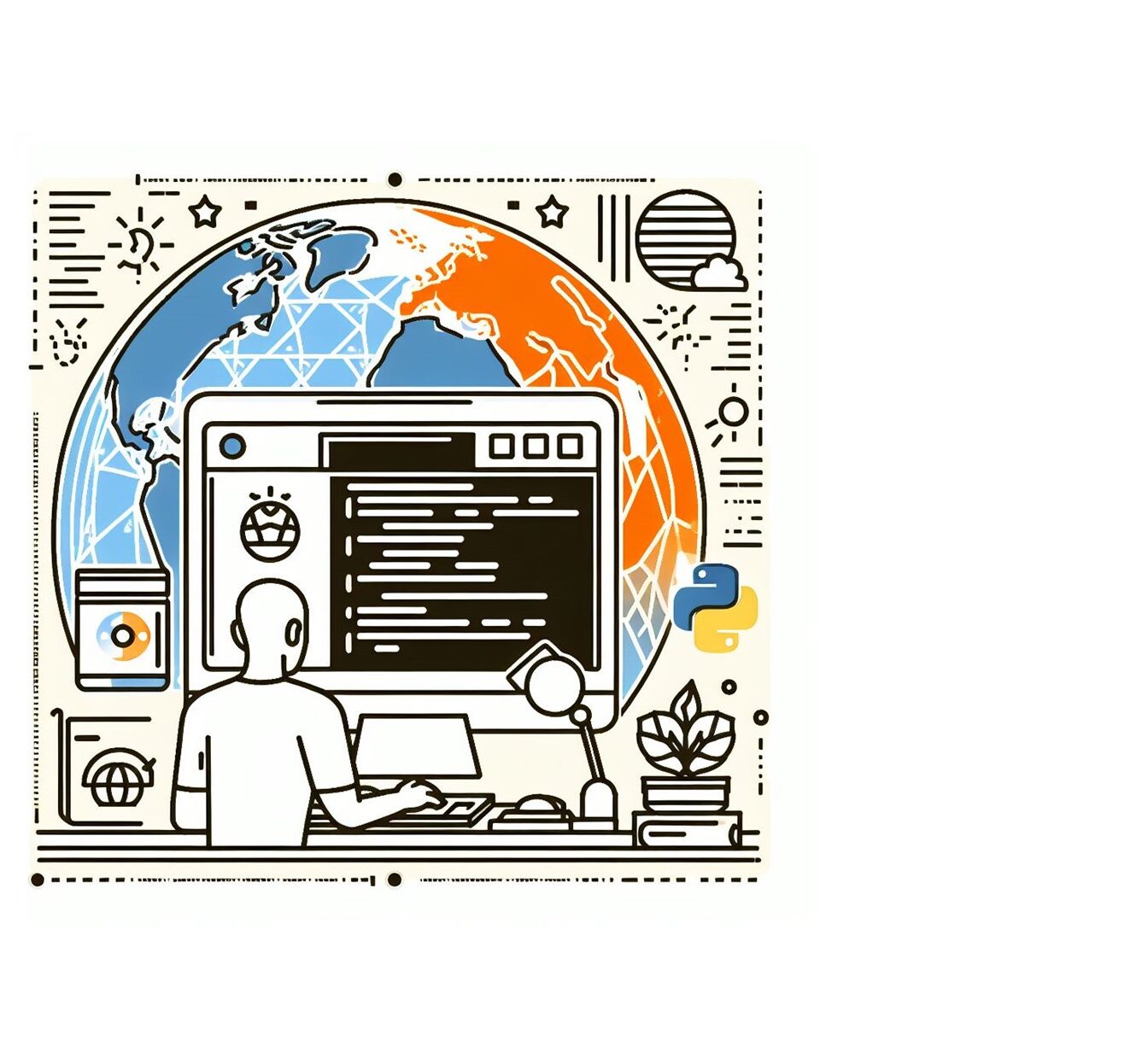
Our course offerings reflect the diversity and depth of the field of software development, with a special focus on geoinformation. Whether you’re just starting out with programming or want to take your skills to the next level, we have the right course for you. Here’s a look at some of our courses:
- Basic and Advanced Programming: Whether you want to learn the basics with Python for Beginners or deepen your skills with Python Advanced, our courses provide a solid foundation.
- Specialization Courses: Dive deeper into specific applications such as Python GeoSpatial for geoinformation projects, or learn how to program drones with Drones with Python.
- Development Tools and Platforms: Strengthen your development workflow with courses like GitHub for version control and project collaboration.
By taking our courses, you can:
- Develop skills in popular programming languages and technologies.
- Specialize in geoinformation applications, essential for working with GIS systems and geodata analysis.
- Gain practical experience by working on projects with direct real-world applications.
Our offerings have been carefully curated to not only provide a broad range of technical skills but also to offer insight into how these skills can be applied within the world of geoinformation. Regardless of your current level or experience, our courses are designed to guide you to the next level of your career. Take a look at our full offerings to find the course that perfectly matches your learning goals.
The Role of Programming Languages in Software Development
Programming languages are at the core of software development, and the choice of language can have a significant impact on a project’s success. In the context of geoinformation and GIS, some languages are particularly valuable due to their specific features and libraries. Let’s take a look at some of the most commonly used programming languages and their importance in this field:
- Python: Popular for its simplicity and the powerful PyGIS and GeoPandas libraries, ideal for data analysis and manipulation of geoinformation.
- JavaScript: Indispensable for developing interactive web applications, with libraries such as Leaflet and OpenLayers that enable rich user experiences in web-based GIS applications.
- Java: Used for building robust, high-quality applications, including Android apps that use geolocation.
- C++: Offers high performance for complex geoinformation systems and forms the basis of much desktop GIS software.
Choosing the right programming language depends on various factors, such as specific project requirements, the development team’s familiarity with the language, and the desired performance of the final product. For example:
- For data analysis and scripting, Python is often the best choice due to its simplicity and extensive support for geoinformation libraries.
- JavaScript is indispensable for creating interactive maps and web applications.
- Java and C++ are recommended for developing performance-intensive applications.
Integrating these programming languages into your skill set can significantly improve your ability to develop effective, efficient solutions to geospatial problems. By taking our courses, you’ll not only gain a deep understanding of these languages but also practical experience applying them in real-world projects. This will enable you to build advanced geospatial systems that make a real impact.
The Importance of Frameworks and Libraries
In the world of software development, and particularly within the field of geoinformation, frameworks and libraries play a crucial role in accelerating development processes and improving the quality of applications. These tools provide a structured foundation upon which you can build, so you don’t have to start from scratch. Let’s take a look at some of the most important frameworks and libraries that are essential in the geoinformation world:
- Leaflet and OpenLayers: Two of the most popular JavaScript libraries for developing interactive maps on web pages. They are flexible, powerful, and easy to use, making them an excellent choice for projects that require rich map visualizations.
- Django with GeoDjango: A high-quality Python web framework that is perfect for building secure and maintainable web applications. GeoDjango adds geospatial functionalities to Django, making it an indispensable tool for developing location-based services and applications.
- PostGIS: A spatial database extension for PostgreSQL that enables the execution of advanced geospatial queries and analyses. It is ideal for projects that process and analyze complex geodata.
Using these frameworks and libraries enables developers to:
- Increase efficiency: By leveraging reusable code and patterns, developers can build and launch applications faster.
- Reduce complexity: They help handle complex tasks such as geospatial data analysis and map visualization, allowing developers to focus on the core functionality of their application.
- Improve quality: Frameworks and libraries are maintained by a community of developers, which means bugs are quickly identified and fixed, and new features are added.
By taking our courses, you’ll not only gain insight into how to use these powerful tools but also gain practical experience applying them in your own projects. This will strengthen your ability to create innovative solutions that make a real impact in the field of geoinformation.
Modern Software Development Methodologies
In the rapidly evolving world of software development, modern methodologies are crucial for managing projects efficiently and effectively. These methods provide flexible frameworks that help teams deliver software faster and with higher quality. Especially within the field of geoinformation and GIS, where projects can be complex and must respond quickly to changing requirements, these approaches are invaluable.
- Agile: Perhaps the best-known methodology, emphasizing flexibility, continuous delivery, and customer feedback. The Agile framework is particularly useful in projects where requirements may change due to new insights or shifting market needs.
- Scrum: A specific implementation of Agile that uses short sprints and daily stand-ups to increase productivity and transparency within teams.
- Kanban: Focuses on visualizing the work process and managing the workflow, enabling teams to work more efficiently and avoid bottlenecks.
- DevOps: Although not a development methodology in the traditional sense, DevOps integrates development and operations to accelerate the delivery of updates and new features, which is essential for maintaining modern, scalable GIS applications.
These methodologies not only support the technical aspects of software development but also foster a culture of collaboration, continuous improvement, and customer focus. This is particularly important in projects related to geoinformation, where the application of data and technology can have a direct impact on decision-making and policy formulation.
By embracing these modern development methodologies, teams can:
- Respond more quickly to changes and new opportunities.
- Deliver higher-quality software through continuous integration and testing.
- Promote better collaboration and communication within the team and with stakeholders.
- Implement more efficient project management processes, leading to timely project delivery.
If you are interested in deepening your knowledge and skills in this area, our courses offer not only the theoretical background but also practical experience with these methodologies, tailored to the unique challenges and opportunities within the geoinformation world.
Future Trends in Software Development
The future of software development looks promising, with numerous emerging technologies set to transform the way we work and live. Especially in the field of geoinformation and GIS, these trends open up new possibilities for analyzing and visualizing data. Here are some of the key trends we can expect:
- Artificial Intelligence (AI) and Machine Learning (ML): These technologies are increasingly being integrated into software development projects, including those in the geoinformation sector. They offer advanced capabilities for data analysis and pattern recognition, which are essential for interpreting complex geospatial datasets.
- Internet of Things (IoT): With the exponential growth of IoT devices, the need for software capable of processing and analyzing real-time geospatial data will only increase. This opens the door to innovative applications in urban planning, environmental monitoring, and more.
- Cloud Computing and Serverless Architectures: The shift toward cloud-based solutions and serverless computing offers developers flexibility and efficiency when building and scaling applications. This is particularly relevant for GIS applications that process large amounts of data and must be accessible worldwide.
- Blockchain Technology: Although often associated with cryptocurrencies, blockchain has the potential to improve the security and transparency of geographic information systems, particularly in applications related to land registration and property rights.
These trends will not only influence the technical aspects of software development but also the way teams collaborate and manage projects. It is important for developers to stay informed about these trends and understand how they can be applied within the context of geoinformation. By continuously updating your knowledge and skills, you can stay ahead in this dynamic field and create innovative solutions that make a real impact. Our courses and training programs are designed not only to teach you about current best practices but also to prepare you for the future of software development in the world of geoinformation.