What does a GIS Operator do?
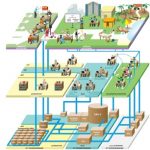 As a GIS Operator, you play a crucial role in managing and visualizing geographic data. Your daily tasks are not only technical in nature but also creative, as you translate complex information into understandable and visually appealing maps. Here are some of the key activities you’ll be involved in:
- Analyzing spatial relationships between different data layers.
- Using GIS software to produce detailed maps that aid in urban planning, environmental management, and more.
- Data processing and editing: accurately entering and updating data in GIS databases.
In addition to these technical skills, you’ll be involved in advising policymakers and stakeholders. Your insights help inform well-founded decisions regarding spatial development and crisis management. This role is therefore not only important for visualizing data but also serves as a bridge between data and practical real-world applications. Your work directly influences how communities develop and how we manage our natural and built environments.
Why is the work of a GIS Operator important?
The work of a GIS Operator is invaluable to both governments and businesses. With your expertise in geographic information systems, you contribute to more efficient processes and better-informed decision-making. Here are a few reasons why your role is so crucial:
- Decision-making: You make data visually accessible, making complex information easier for decision-makers to understand.
- Risk management: By mapping natural hazards and land use, you help plan measures to minimize risks.
- Development and planning: Your work supports urban planning and development, enabling cities to grow more sustainably and efficiently.
Every map layer you create or edit has the potential to make a significant impact. Whether it involves managing natural resources, planning new infrastructure, or responding to crisis situations, your skills ensure that critical information is available and up-to-date. This makes your role not only relevant but also indispensable in the pursuit of a well-organized and informed society.
Geo-information plays a fundamental role in the daily tasks of a GIS Operator. This data not only helps shape the physical world around us but also directly influences how you perform your work. Below are some key influences:
- Real-time decision-making: With up-to-date geoinformation, you can respond quickly to changing conditions, such as weather changes or emergencies.
- Improved accuracy: You use geo-information to increase the precision of maps and spatial analyses, which is essential for accurate planning and implementation.
Integrating geospatial data into your workflow not only makes you more efficient but also provides a deeper understanding of the geographic context. This is crucial for tasks such as planning urban expansion or environmental management. Your expertise ensures that this information is transformed into actionable insights that have a direct impact on decision-making across various sectors. As a result, your role as a GIS Operator is indispensable in the effective use of geoinformation.