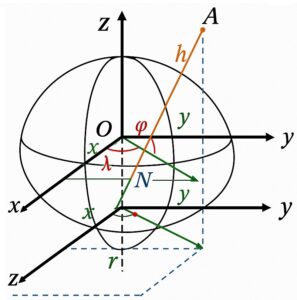
In Geo-ICT, the geodetic engineer plays a key role in connecting measurement data from the physical world with digital systems that manage, analyze, and visualize spatial information. In this context, the geodetic engineer focuses primarily on the quality, accuracy, and consistency of spatial data within geographic information systems (GIS).
He or she ensures that all data is correctly georeferenced to a reliable coordinate system, so that different datasets (such as aerial photographs, cadastral maps, elevation models, and sensor data) align seamlessly.
The engineer advises on transforming data between different coordinate systems and performs checks on geometric precision and system integrity. Tools such as FME, ArcGIS, QGIS, and geodetic calculation modules are used for this purpose, often in combination with scripting (e.g., Python) to automate data flows.
The geodetic engineer also plays a role in setting up and managing geodatabases, defining metadata standards, and supporting applications in which location-critical decisions are made, such as in urban planning, asset management, or civil engineering. In this way, they act as a quality assurance specialist for spatial data within digital environments.