Geodetic Supply Chain

Geodesie

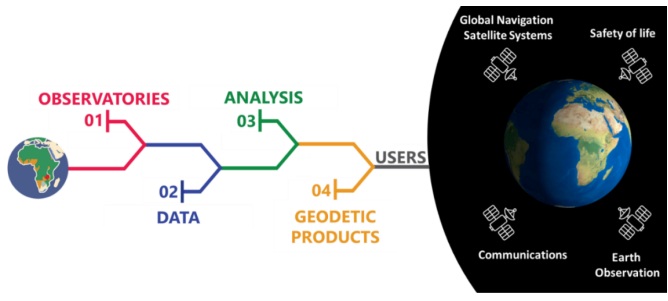
In this Geodetic Supply Chain course, you will learn what makes it possible for us to use GNSS systems, satellites, and coordinate systems. The global geodetic supply chain consists of ground observation stations, data centers, analysis centers, and highly qualified experts who observe the Earth and convert these observations into geodetic products that are essential for accurate and reliable communication with satellites.

Course duration: 1 day

Taught by:

Ad van Gils
Nederlands

Introduction to the Geodetic Supply Chain (Course)

What is geodesy?

Geodesy is the science concerned with measuring and mapping the shape, size, and gravitational field of the Earth. This knowledge forms the basis for land surveying, mapmaking, and the dimensioning of construction and infrastructure projects.

In surveying, we use GNSS (Global Navigation Satellite Systems), among other tools. Additionally, geodetic data is applied in various other sciences, utilizing satellites that provide more than just navigation data.

The role of geodesy?

The Earth is constantly moving relative to other celestial bodies. Satellites in orbit around the Earth also continuously change position. Geodesy determines the relative positions of these objects and calculates these movements to ensure high accuracy. This science provides crucial measurement data—so-called geodetic products—to surveyors, hydrographers, and climate scientists, among others.

What is the geodetic supply chain?

The geodetic supply chain consists of:

  • Ground observation stations (approximately 1,800 spread across the globe)
  • Data centers
  • Analysis centers
  • Highly qualified experts

This chain ensures continuous observation of the Earth and the conversion of observations into products that are essential for accurate communication with satellites.

Geo-ICT Training Center, Nederland - Cursus geodetische Supply Chain


Note: For basic knowledge of GNSS/GPS systems, satellites, and coordinates—essential for understanding the fundamentals of a geodetic supply chain—please review the GPS basics course

An important component of this is the Global Geodetic Observing System (GGOS), managed by the International Association of Geodesy (IAG).

The International Terrestrial Reference Frame (ITRF)

The ITRF is the consistent reference frame against which all geodetic measurements are benchmarked. To ensure accuracy, new versions of the ITRF are regularly released based on data from over 1,800 observatories worldwide.

The four geodetic observation techniques

  1. GNSS (Global Navigation Satellite Systems)
    Measures positions on Earth using signals from satellites (such as GPS and Galileo) to track plate movements and sea level changes, among other things.

  2. VLBI (Very Long Baseline Interferometry)
    Measures distances between radio telescopes using signals from quasars; accurately determines Earth’s rotation and orientation.

  3. SLR (Satellite Laser Ranging)
    Sends laser pulses to satellites and measures the reflection time; provides insight into distance and the gravitational field.

  4. DORIS (Doppler Orbitography and Radiopositioning Integrated by Satellite)
    Measures position and velocity with high accuracy using radio signals; useful for satellite orbits and sea level monitoring.

Application in climate research

Geodetic data are indispensable for climate science and the development of adaptation strategies.

  • Sea level monitoring | Detection of long-term trends via satellite altimetry and tide gauges, supported by geodetic techniques.
  • Monitoring of vertical land movement | Measuring land subsidence or uplift using GNSS to distinguish it from sea level rise, important for coastal areas.
  • Monitoring of ice sheets and glaciers | GRACE and GRACE-FO missions measure ice mass loss in Antarctica and Greenland, essential for sea level rise predictions.
  • Atmospheric and oceanic circulation | Gravity measurements reveal mass shifts caused by melting ice, ocean dynamics, and changes in land hydrology.
Read more

Enroll

€795,- (VAT included)
  • Course duration: 1 day
Register for this course

Course Schedule for Geodetic Supply Chain

Day 1

9:00 – 9:30 AM: Welcome and introduction

  • Welcome, introduction of participants
  • Purpose and schedule for the day
  • Brief introduction: What is geodesy?

9:30 – 10:30: Session 1 – Fundamentals of Geodesy

  • The shape, size, and gravity of the Earth
  • What do we measure and why?
  • GNSS and the importance of coordinates and reference frames
  • Interactive session: practical examples of surveying and dimensioning

10:30 – 10:45 | Break

10:45 – 12:00: Block 2 – The Global Geodetic Infrastructure

  • What is the geodetic supply chain?
  • Role of GGOS and IAG
  • The International Terrestrial Reference Frame (ITRF)
  • Case study: how a stable reference frame is established

12:00 – 13:00 | Lunch break

13:00 – 14:30 | Session 3 – The four observation techniques explained

  • GNSS, VLBI, SLR, DORIS – operation and applications
  • How these techniques come together in the ITRF
  • Importance for accuracy and continuity
  • Demo or visualization: geodetic observatory in operation

2:30 PM – 2:45 PM | Break

2:45 PM – 3:45 PM: Session 4 – Geodesy and Climate Science

  • Monitoring of sea level, land movement, and ice mass
  • The role of GRACE & GRACE-FO
  • Mass distribution, gravity measurements, and ocean circulation
  • Discussion: How geodesy contributes to climate adaptation policy

3:45 PM – 4:15 PM | Session 5 – Future and societal relevance

  • The vulnerability of geodetic infrastructure
  • Why this knowledge needs to be shared more widely
  • Interdisciplinary collaboration

4:15 – 4:30 PM | Conclusion and Q&A

  • Summary of the day
  • Open Q&A
  • Evaluation and closing
Course duration: 1 dag
Sign me up

Leerdoelen

The participant:

  • Learns how the geodetic supply chain works. Who maintains the coordinate systems and how is this done? How is the Earth’s position in space determined, and how are the positions of satellites determined in space and relative to the Earth? How does geodesy integrate all these elements and ensure the correct corrections are applied?
  • Becomes aware that geodesy is essential for the functioning of critical infrastructure and economic development.
  • Learn that action is needed to keep the global geodetic supply chain robust and sustainable to support efficient and effective decision-making.
  • Become aware of how geodesy is applied to accelerate the realization of the UN’s Sustainable Development Goals.

Want to know more?

Do you have questions about the course content? Or are you unsure whether the course aligns with your learning goals or preferences? Would you prefer an in-house or private course? We’d be happy to help.

Other courses

Frequently Asked Questions About the Geodetic Supply Chain Course

In this course, you will learn how the global geodetic infrastructure works, from satellite measurements to data processing. You will gain insight into the International Terrestrial Reference Frame (ITRF), the measurement instruments used—such as GNSS, VLBI, SLR, and DORIS—and how geodesy is applied in fields such as infrastructure, climate research, and risk management.

The course is suitable for (prospective) surveyors, hydrographers, GIS specialists, climate researchers, and other professionals who work with geospatial data. It is also relevant for policymakers and engineers who want to gain a better understanding of the infrastructure behind precise positioning.

A basic understanding of geography, surveying, or GIS is helpful but not required. The course begins with an introduction to the fundamentals of geodesy and gradually builds toward more complex concepts such as reference frames and global measurement networks.

The ITRF is the standard on which all precise position measurements worldwide are based. It makes it possible to reliably measure and compare changes on Earth—such as sea-level rise, tectonic plate movements, or land subsidence.

Geodetic measurements provide crucial data on changes in sea level, the melting of ice sheets, and vertical land movement. This information is indispensable for climate models, policy-making, and the development of adaptation strategies for vulnerable areas.

The global average sea level is determined using a combination of various measurement methods, with geodesy playing a crucial role. Below is an overview of how this is done:

1. Satellite altimetry (space-based measurements)

  • What: Satellites such as TOPEX/Poseidon, Jason-1/2/3, and Sentinel-6 measure the distance between the satellite and the sea surface using radar.
  • How: This distance is combined with the satellite’s exact position (determined by geodetic techniques) to calculate the height of the sea surface.

Geodesy: Precise positioning of the satellite is made possible by geodetic systems such as GPS, DORIS, and laser ranging (SLR). Without these techniques, the measurement would be inaccurate.

2. Tide measurements (tide gauges, historical)

  • What: Long-term measurements of sea level along the coast.
  • How: These provide insight into regional and local changes.

Geodesy: By using GNSS receivers at these measuring stations, ground movement can be corrected, making the distinction between sea level rise and land subsidence clear.

3. Gravimetry (measuring mass changes)

  • What: Satellites such as GRACE and GRACE-FO measure changes in the Earth’s gravitational field.
  • How: These changes indicate mass shifts such as melting ice caps or changes in ocean mass.

Geodesy: Gravimetry is a branch of geodesy that helps explain why sea levels are changing, not just by how much.

4. Global Reference Frame

What: Consistent global measurements require a stable coordinate system (such as the ITRF).

Geodesy: Provides this reference frame through techniques such as VLBI, SLR, GNSS, and DORIS. This is essential for interpreting elevation changes on a global scale. Without geodesy, sea level measurements would be inaccurate and not comparable across time and location.