
Multi-Beam Survey

Geodesie

A multibeam hydrographic survey is conducted to map the seabed, riverbeds, or lake beds in order to determine the topography of the underwater surface.

Course duration: 4 days

This course is taught online (virtual classroom) in English by Ebelien van der Velde.
For more information in English, download the information PDF.Geo-ICT Training Center, Nederland - Multi Beam Survey
Introduction to Hydrography

In the fascinating world of hydrography, knowledge of the seabed plays a crucial role—not only for shipping but also for underwater research and environmental conservation. Hydrography revolves around mapping and studying bodies of water, utilizing advanced technologies such as multibeam echo sounder systems to collect depth measurements and topographic data of underwater surfaces. This information is invaluable for creating accurate nautical charts, planning maritime routes, and supporting coastal management and underwater archaeology projects.

Our Multi-Beam Survey Course not only covers the theoretical foundations of hydrographic principles but also places a strong emphasis on practical applications—from operating multi-beam echo sounders to processing bathymetric data. The course prepares you for a range of professional challenges.

The technologies you’ll learn are not only fascinating but also essential for modern geodata collection and analysis. By immersing yourself in this course, you’ll become part of a specialized community that shapes the way we understand our planet. This is your chance to contribute to both geoinformation science and the protection of our marine ecosystems with authoritative knowledge and compelling insights.

Are you ready to explore the depths of hydrography and take your skills to the next level? Geo-ICT is waiting for you with a course that will not only enrich your career but also your perspective on the underwater world.

Fundamentals of Hydrography

The fundamentals of hydrography lay the foundation for anyone who wants to understand the complex and fascinating world of seabed mapping. These principles are key to conducting accurate and reliable hydrographic surveys. Here’s a look at what’s essential:

  • Principles of Sonar Technology: Understanding how sonar works is crucial. Sonar technology, as used in multibeam echo sounder systems, allows us to create detailed images of the seabed.
  • Navigation and Positioning: Accurate positioning is essential for the quality of hydrographic data. Techniques such as GPS and other navigation systems are indispensable.
  • Data Processing and Interpretation: Collecting data is just the beginning. The skill lies in interpreting and converting this data into accurate geographic information maps.

The course at Geo-ICT offers in-depth insight into these and other fundamental aspects of hydrography. You will learn not only about the technical side but also about its application in real-world scenarios. This prepares you for a career in which your work will actively contribute to a better understanding of our water-rich planet.

By embracing this knowledge base, you’ll be equipped with the skills to make essential contributions to geoinformation science, maritime safety, and environmental protection. With Geo-ICT as your guide, you’re at the start of a fascinating journey into the world of hydrography, where every wave and every grain of sand counts.

Technology Behind Multi-Beam Survey

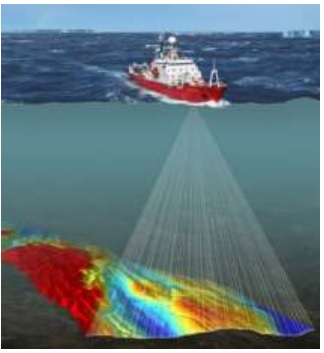
The technology behind Multi-Beam Survey is truly revolutionary and forms the backbone of modern hydrographic surveys. This technology utilizes advanced sonar systems that simultaneously transmit multiple sound pulses (beams) across a wide area beneath a ship. This enables us to obtain a much more detailed and accurate image of the seabed than was ever possible before.

Some key components of this technology are:

  • Multi-beam echo sounder systems: These systems transmit and receive multiple sonar beams, creating a 3D image of the seabed.
  • Advanced data processing: The collected data must be accurately processed and interpreted to provide reliable geographic information.
  • Integration with other data: Combining multibeam data with data from other sources, such as satellite imagery, increases the accuracy and usability of hydrographic charts.

This technology offers unprecedented possibilities for studying the underwater world—from depth measurement and navigation to environmental research and mapping archaeological sites. By delving into our Multi-Beam Survey Course, you’ll not only gain a deep understanding of this technology but also practical experience in using it. This opens new doors to opportunities within the world of geoinformation and hydrography. In doing so, you’ll contribute to important discoveries and help make maritime navigation safer.

What will you learn in the Multi-Beam Survey Course

Knowledge of Multi-Beam Echo Sounding Systems

Understanding and operating multi-beam echo sounder systems is central to the course. These systems, crucial for modern hydrographic surveys, provide detailed information about the seabed. Some key aspects you will learn include:

  • How the system works: How multi-beam echo sounders transmit and receive sound pulses to measure depth and seabed contours.
  • Calibration and maintenance: Essential procedures to ensure accurate results.
  • Data interpretation: Developing skills in reading and analyzing the collected data to create accurate geographic information.

This knowledge enables you to confidently participate in projects that require the seabed to be accurately mapped. By developing your skills in using this advanced technology, you enhance your value as a professional in geoinformation and contribute to important discoveries in both science and industry.

Data Acquisition and Processing

Collecting and processing data is a crucial step in the hydrographic survey process. The Multi-Beam Survey Course guides you through the most important techniques and tools. You will learn how to:

  • Develop efficient data acquisition strategies aimed at maximizing coverage and accuracy.
  • Use advanced software tools to process and analyze collected data, thereby producing detailed and accurate underwater maps.

These skills are essential for anyone working in the field of geoinformation, as they form the foundation for creating reliable datasets that can be used for navigation, research, and environmental conservation.

Why choose our Multi-Beam Survey Course?

Choosing our Multi-Beam Survey Course means opting for an in-depth and hands-on learning experience in the world of hydrography and geoinformation. Here are a few reasons why this course stands out:

  • Expertise and Experience: Geo-ICT is renowned for its expertise and has a rich history of providing high-quality education in the field of geoinformation technologies.
  • Practical Training: The course is designed to provide you not only with theoretical knowledge but also with practical skills that can be immediately applied in your professional life.
  • Modern Technologies: You’ll gain hands-on experience with the latest multi-beam echo sounder systems and learn how to use them effectively for underwater mapping.

This combination of factors makes our course an essential step for anyone who wants to deepen or expand their career in geoinformation science.
Read more

Enroll

€1795,- (VAT included)
  • Course duration: 4 days
Register for this course

Dagindeling

Day 1

  • Starting with the end in mind: An introduction to the importance of beginning with a clear goal, focusing on what the client expects and what high-quality multibeam data looks like.
  • What is Multibeam Sonar: An explanation of the technology, how it works, and its importance in hydrographic surveys.
  • What the client requested: Discussion of client specifications and how to translate them into survey parameters.
  • Multibeam Data Quality Control: Focus on what to look for during data acquisition for quality control, including an initial check of acquired data.
  • Introduction to Geodesy: Basic principles of geodesy relevant to hydrographic surveys.
  • The software workflow: From setup to map—an introduction to the process flow.
  • Manufacturers, Models – Introduction: Overview of major manufacturers and models of multibeam sonar.
  • Equipment selection: Discussion of what equipment is needed for a successful survey

Day 2

  • The layout of a hydrographic survey vessel: An overview of how a survey ship is equipped.
  • Sensors on board a hydrographic survey vessel: Introduction to the various sensors and their functions.
  • Multibeam, Motion Sensor, Gyro Compass, GNSS, Time Synchronization: In-depth discussion of each of these components.
  • Mobilization of the survey vessel Part 1: The process of calibrating the vessel and the survey equipment.
  • Calibration of the survey equipment: Importance and methods of calibration for accuracy.

Geo-ICT Training Center, Nederland - cursus Multi beam survey


Day 3

  • Deployment of the survey vessel, Part 2: Continuing the setup and preparing for the survey.
  • Creating a basic setup in the survey software: Steps for configuring the software.
  • Interfacing the survey equipment with the survey software: How the hardware and software work together.
  • Checks and calibrations: Performing checks and calibrations of the multibeam, gyro, motion sensor, and GNSS.
  • Fixed Point / Control Point Surveying (Land Surveying), Reading the Sounding Scale: Methods for ensuring accuracy.

Day 4

  • Best practices for conducting surveys.
  • The Sonar GUI or Topside Unit: User guide for the sonar interface, including dos and don'ts.
  • Data Acquisition: Practical exercises, either on a simulator or by replaying real survey data.
  • Quality Control During Acquisition, Data QC/QA: Continuous quality control process during data acquisition.
  • Reporting: How to write an effective survey report that meets client requirements.
  • Data Processing and QC/QA: Steps for cleaning data and creating maps.
Course duration: 4 dagen
Sign me up

Leerdoelen

The following learning objectives ensure that participants gain a thorough foundation in both the theoretical and practical aspects of multibeam hydrographic surveying, preparing them for a wide range of professional applications.

  • Understanding the Fundamentals of Hydrography:
    Students learn about the fundamental concepts of hydrography, including the principles of sonar technology, the importance of accurate nautical charts, and the role of hydrography in maritime navigation, underwater exploration, and environmental research.
  • Knowledge of Multi-Beam Echo Sounder Systems:
    Students gain in-depth knowledge of the operation, configuration, and maintenance of multi-beam echo sounder systems. This includes understanding the technical specifications, onboard installation, and calibration of the equipment.
  • Data Acquisition and Processing:
    Participants learn how to collect data using multi-beam echo sounder systems, including planning survey routes, conducting surveys, and collecting bathymetric, sonar image, and water column data. They also learn about the processing and interpretation of this data to produce accurate underwater maps.
  • Quality Control and Assurance:
    Participants gain insight into the quality control and assurance methods essential for ensuring the accuracy and reliability of the collected hydrographic data. This includes learning about sources of error, validating data, and applying corrections where necessary.
  • Applications and Case Studies:
    Students explore the various practical applications of multi-beam hydrographic surveys, such as in shipping, coastal zone management, offshore construction projects, environmental studies, and underwater archaeology. Through case studies and potential fieldwork, they learn how theory and practice come together in real-world projects.

Want to know more?

Do you have questions about the course content? Or are you unsure whether the course aligns with your learning goals or preferences? Would you prefer an in-house or private course? We’d be happy to help.

Other courses

Frequently Asked Questions About Multi Beam Survey

The Multi-Beam Survey course at Geo-ICT Training Center provides in-depth knowledge and practical experience with multi-beam echo sounder techniques for mapping lake and riverbeds.

This course is ideal for entry-level geospecialists, experienced geoprofessionals, companies in the geospatial sector, individuals seeking career transitions, and educational institutions looking to develop or refine their skills in hydrographic survey techniques.

Participants can earn a certificate that recognizes their knowledge and skills in multi-beam survey techniques, such as depth measurement and water depth mapping.

To participate in the Multi-Beam Survey course, a basic understanding of geographic information systems (GIS) and an interest in marine geography are recommended, but highly motivated beginners are also welcome.