What a 3D Scan Operator Does
As a 3D scan operator, you’re the behind-the-scenes artist who digitally captures the world around us. Your role is crucial for creating accurate 3D models of objects and environments. But what exactly does this job entail? Let’s take a look at a typical day:
- Performing scans: You spend your days carefully scanning objects and buildings. Each scan is a building block for a larger whole.
- Planning and preparation: Before the scanner starts whirring, you’re busy planning the scan positions and adjusting the scan settings. These preparations ensure that every detail is captured.
- Working with advanced technology: Your hands operate both laser scanners and photogrammetric cameras—tools essential for capturing our physical world in digital form.
- Quality control: After the scans comes quality control. You search for technical issues and errors, ensuring the collected data is of the highest quality.
- Data processing: You’ll use the collected data to generate point clouds and mesh models—the building blocks of every 3D model.
- Generating 3D Models: The most creative part of your work. You bring the scans to life by texturing them, creating lifelike 3D models.
Your work as a 3D scan operator is not only technically challenging; it is also an essential link in the chain that helps create digital worlds, from designing buildings to reconstructing historical sites. By bridging the gap between the physical and digital worlds, you play a vital role in diverse projects and industries.
Are you ready for this challenging and rewarding career? Your expertise in geoinformation and 3D scanning opens doors to unprecedented possibilities.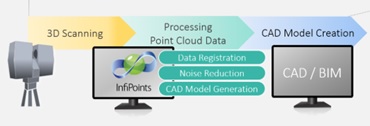
Why is the work of a 3D scan operator important?
The profession of 3D scan operator is not only fascinating but also crucial to many sectors. Why? Because the digital replicas you create form the basis for innovations and developments in countless fields. Here are a few reasons why your work matters:
- Precision and efficiency: By capturing objects and environments down to the smallest detail, you contribute to accurate and efficient planning in construction projects, product design, and even the entertainment industry.
- Cultural heritage: You help preserve cultural heritage by digitally documenting historical monuments and artifacts, ensuring they are preserved for future generations.
- Fostering innovation: The data and models you produce are essential for research and development in science, architecture, and urban planning, with every scan opening up new possibilities.
- Improving safety: In the industrial sector and in infrastructure projects, your work is used to conduct safety analyses, mitigate risks, and improve safety for everyone.
Your role as a 3D scan operator goes beyond simply operating technical equipment; you are a key figure in shaping our future. By translating the physical world into accurate digital models, you open the door to new discoveries and help build a better world.
Geo-information plays an indispensable role in the work of a 3D scan operator. This information is not only crucial for capturing the physical world, but also for its interpretation and practical application in digital models. Here are some ways in which geo-information makes a difference:
- Location determination: For accurate scanning, it is essential to know exactly where each object is located in space. Geoinformation helps determine these locations.
- Scan planning: With geoinformation, you can determine the most effective scan positions and routes, allowing you to work efficiently and collect the highest quality data.
- Analysis and application: After collecting scans, you use geoinformation to analyze the collected data and convert it into usable models for various purposes.
Understanding and applying geoinformation enables you, as a 3D scan operator, to perform your work with greater precision and effectiveness, thereby contributing to the development of accurate and valuable digital models.