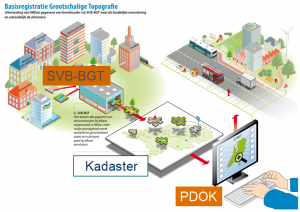
At Geo-ICT, we understand the crucial role the BGT plays in the system of basic registries. Our BGT Training is specifically designed to introduce you to the basic principles of this large-scale topography and to develop your skills in effectively using and interpreting BGT data. With this knowledge and these skills, you can make a significant contribution to infrastructure projects, urban planning, and geodata management.
What makes the BGT so special is the uniformity and coverage of the data. Every object in the outdoor environment is recorded according to a standardized method, ensuring a consistent and reliable representation of reality. These characteristics are essential for accurate geoinformation provision and form the basis for countless applications in geoinformation technology.
In the BGT course, we dive deep into the possibilities it offers. From BGT measurements using a GPS receiver to working with a Total Station, you’ll learn the ins and outs of the trade. We’ll also focus on the management and updating of BGT data. These two aspects are crucial for maintaining this extensive database.
For the necessary interaction, we use the open-source software product QGIS. Prior knowledge of QGIS is not required, but it is helpful.
More interested in what the BAG (Basic Registration of Addresses and Buildings) does? Then the BAG course might be for you!
Understanding the basics of BGT
To fully understand the Large-Scale Topography Database (BGT), it is essential to start with the fundamental concepts that shape this detailed map of the Netherlands. The BGT is not just any map; it is a living document that is constantly updated to provide an accurate picture of our physical world. This understanding is crucial, especially if you are involved in planning, design, or management of the space around us. Here are some key points:
- Uniformity and Accuracy: Every object in the outdoor environment, from buildings to waterways, is recorded with an accuracy of up to 20 centimeters.
- Up-to-Date Data: The BGT is continuously updated to accurately reflect the changing environment.
These basic principles are fundamental for anyone working with geoinformation. They ensure that we have a reliable, detailed source of geographic data that is widely applicable. From infrastructure projects to urban planning, the BGT provides a solid foundation for all kinds of applications.
At Geo-ICT, you’ll not only learn these fundamentals but also get hands-on experience. You’ll learn how to:
- Interpret data: Understand what the information means and how you can use it in your projects.
- Apply technology: Use GPS receivers and Total Stations to collect and process BGT data.
These skills are indispensable in today’s geoinformation technology. By linking theory to practical exercises, we ensure that you not only gain knowledge but can also apply it immediately. This way, you’ll become a true expert in large-scale topography, ready to make a difference in the world of geodata.
Importance of BGT for Spatial Development
The Large-Scale Topography Base Register (BGT) plays a crucial role in the spatial development of the Netherlands. This digital foundation provides unparalleled geoinformation that is essential for all kinds of spatial planning and development. Whether it involves the construction of new infrastructure or the redevelopment of urban and rural areas, the BGT offers the necessary precision and reliability. Let’s take a look at some specific ways in which the BGT contributes to spatial development:
- Support for infrastructure projects: Detailed data on the landscape aids in the design and planning of roads, bridges, and other essential infrastructure projects.
- Urban planning and management: Urban planners use BGT data to effectively develop and manage urban areas, taking into account green spaces, buildings, and water.
- Environmental and nature conservation: The BGT provides information that is crucial for the preservation and protection of natural habitats and the management of water levels.
These applications highlight how geodata is not merely technical in nature but actually influences our living environment and how we approach spatial issues. At Geo-ICT, we understand the importance of this data and ensure that our students learn how to use this information to drive positive change in spatial development. Our course not only provides theoretical knowledge but also places a strong emphasis on practical skills. You will learn:
- How to interpret and apply BGT data in various projects.
- The importance of data accuracy and timeliness for the successful execution of spatial projects.
With this knowledge and these skills, you can make a valuable contribution to the geodata world and help shape the development of our physical environment. By participating in our course, you’ll become part of a growing group of professionals who are shaping the future of our spatial environment.
What will you learn in the BGT Course
Core principles and components of the BGT
The Large-Scale Topography Base Register (BGT) is an indispensable link in the management and use of geoinformation in the Netherlands. This digital map records every physical object in our living environment, from buildings and roads to waterways and green spaces. To fully understand the value of the BGT, it is important to examine its core principles and key components:
- Unambiguity: Each object is recorded in a standardized manner, making the data universally usable for all users.
- Accuracy: With a precision of up to 20 centimeters, the BGT provides a highly detailed picture of the Dutch topography.
- Timeliness: The data in the BGT is continuously updated to accurately reflect changes in the physical environment.
These principles ensure that the BGT is a reliable and indispensable source of information for a wide range of applications, from spatial planning to environmental management. The components of the BGT include buildings, roads and paths, water, and green spaces.
At Geo-ICT, we focus not only on teaching the theoretical knowledge of these core principles and components, but also on how to apply this information practically in your work or projects. By participating in our BGT course, you’ll gain in-depth insight into how the BGT is structured and how you can use this data to visualize, analyze, and manage geoinformation projects. You’ll learn how to:
- Effectively interpret and apply BGT data in your field of work.
- Use technological tools such as GPS and Total Stations to collect and update BGT data.
By developing this knowledge and these skills, you will become a valuable player in the world of geoinformation, with the ability to contribute to the development and management of our physical environment.
Practical Skills in BGT
Developing practical skills in working with the Large-Scale Topography Database (BGT) is essential for anyone active in the geoinformation sector. These skills enable you to apply theory in practice, allowing you to work more effectively on projects that depend on accurate and up-to-date geodata. At Geo-ICT, we emphasize teaching these crucial skills:
- Data analysis and interpretation: The ability to analyze and interpret BGT data is fundamental. You will learn how to extract information from the BGT and apply it in various contexts.
- Use of technological tools: Working with the BGT requires proficiency in various technological tools. We’ll teach you how to:
- use GPS receivers to capture geodata.
- Use total stations for precise measurements.
- Apply GIS software such as QGIS to manage and visualize BGT information.
These skills are not only useful; they are indispensable for professionals working with geoinformation. By mastering these techniques, you can increase the reliability of your projects and contribute to better decision-making based on geodata.
In our course, you combine theory with practice, giving you an in-depth understanding of the BGT and how to apply this knowledge in your daily work. Our BGT Course provides the knowledge and hands-on experience you need to excel in geoinformation technology.
Why choose our BGT training at Geo-ICT?
Choosing the BGT Course at Geo-ICT means choosing quality, expertise, and a practical approach. We stand out through a combination of unique advantages that together guarantee an optimal learning experience. Here are the main reasons why our course is the perfect choice for anyone who wants to deepen their knowledge and skills in geoinformation:
- Expert Instructors: Our instructors are experts in their field with years of experience in both the teaching and practical application of BGT and geoinformation technology. They share not only their knowledge but also their passion for the subject.
- Practical Approach: We strongly believe in learning by doing. Our course therefore includes many practical exercises that you can immediately apply to realistic scenarios. This ensures that you not only understand the material but can also apply it in your daily work.
- Small Groups: To ensure personal attention and guidance, we work with small groups. This allows us to address individual questions and provide everyone with the help needed to fully master the material.
- Up-to-Date and Relevant Content: The content of our course is constantly updated to ensure you learn to work with the most current data and technologies. This way, you’re always up to date on the latest developments in the field of geoinformation.
Choosing the BGT Course at Geo-ICT means choosing a deep understanding of large-scale topography and the practical skills to apply this knowledge in the real world. Whether you’re looking to start your career or advance in the world of geoinformation, our course provides the knowledge, skills, and connections you need to succeed.