
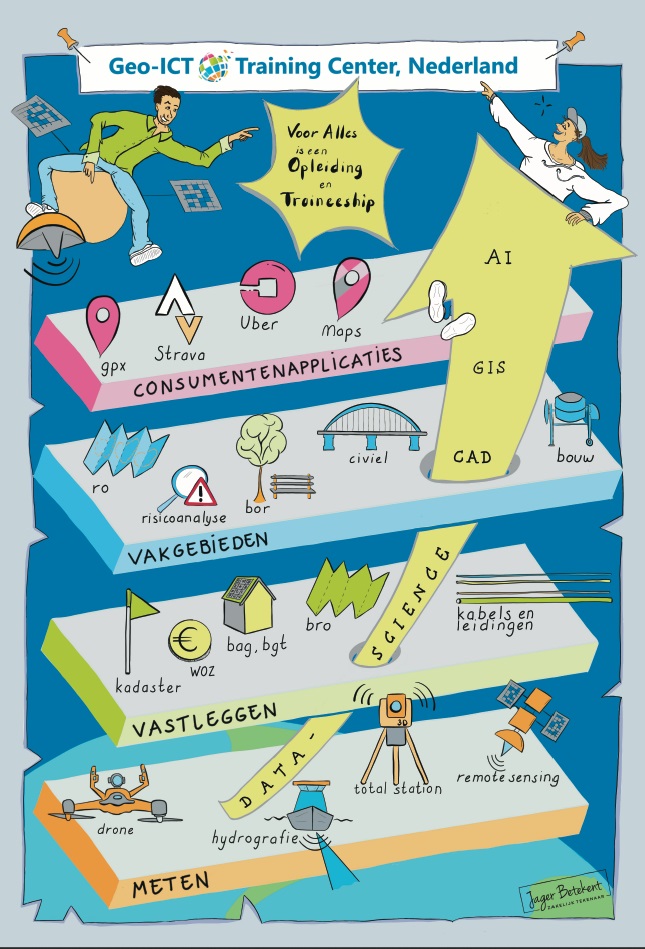
 Geo-ICT Training Center, Netherlands offers more than 150 courses organized into the following categories.
- Everything About QGIS – QGIS-Certified Courses
- Artificial Intelligence – Real-world (geo) applications of AI
- Basic Registries – BAG, WOZ, BGT, BRO, KAD, PDOK
- Construction and Civil Engineering – Digital Dimensioning and BIM
- CAD – Creating Detailed Drawings and Models
- Data Analysis – Interpreting and Analyzing Geodata
- Databases – Organizing and Making Data Accessible
- Data Management – Managing and Applying Data
- Defense – Applying Geo-Intelligence in Defense
- Drones and Remote Sensing – Scans and satellite geodata
- Extract, Transform, Load – Conversions Using ETL and ELT
- Geodesy and Hydrography – The foundation of all geoinformation
- GeoGaming – Using 3D Models in Games
- GeoMarketing – Applying GIS to Market Analysis
- Healthcare – Applying GIS in healthcare
- GIS – Visualizing and analyzing geospatial data
- Google – Using Google Maps and Google Earth Engine
- Internet of Things – The world of geosensors
- Cables and Pipelines – Tracking, Managing, and Installing
- Climate – Analyzing Satellite Data and Identifying Patterns
- Agriculture – Applying GIS in agriculture
- Education and Retraining – Geo-ICT in Education
- Programming Languages – Various languages and their integration with GIS
- Python – Various Python development courses
- Land Use Planning – Creating Digital Land Use Plans
- Visualization and WebGIS – Dashboards and geo-portals
- Water Management – Learn to analyze water systems using GIS, open data, satellite information, and GeoAI.
- Workflows – AI agents that perform actions autonomously
Geo-ICT, or Geographic Information and Communication Technology, involves the use of technology to acquire, manipulate, analyze, manage, and present geographic information. It integrates geographic data with information and communication technologies to solve complex problems related to geography, spatial analysis, and location-based services. Examples of Geo-ICT applications include Geographic Information Systems (GIS), remote sensing, the Global Positioning System (GPS), location-based services, and spatial analysis. These technologies play a crucial role in various fields, such as urban planning, environmental and nature conservation, transportation, agriculture, and disaster management. We offer a variety of courses and blended learning programs in this field, organized into different categories.